Here's the version of gratitude most kids get taught: say thank you, it's polite. True, but genuinely undersells what the research has actually found. Gratitude, studied properly, isn't etiquette. It's one of the more reliably effective tools in positive psychology for a child's actual wellbeing — and the research behind it is more specific and more surprising than "be thankful for what you have."
The Study That Moved Gratitude From Manners to Science
In 2008, researcher Jeffrey Froh and colleagues ran a randomized study with 221 early adolescents, assigning eleven classrooms to either a gratitude condition (counting blessings), a hassles condition (listing daily annoyances), or a control condition. The gratitude group showed measurably higher self-reported gratitude, optimism, and life satisfaction, and decreased negative affect — not just immediately after the exercise, but at a three-week follow-up. The most striking finding: a robust relationship between the gratitude practice and satisfaction with school itself, sustained over time.
This wasn't a one-off. Froh's subsequent research, spanning over a decade, has consistently found similar patterns — a simple, brief gratitude practice, done consistently, produces measurable shifts in adolescent wellbeing that hold up beyond the initial exercise.
The Genuinely Surprising Finding: Gratitude and Materialism
Here's the result that goes beyond the obvious "gratitude feels nice" conclusion. In a large study of over 1,000 high school students, Froh and colleagues found that gratitude and materialism pulled adolescent outcomes in opposite directions — gratitude uniquely predicted higher grade point average, life satisfaction, and social integration, along with lower envy and depression, even after controlling for materialism. Materialism, controlling for gratitude, predicted the reverse pattern on several of the same measures.
The implication is worth sitting with directly: gratitude functions, at least in part, as a genuine counterweight to materialistic values in adolescents — not by lecturing a teenager about not caring so much about possessions, but by actively strengthening a different orientation that tends to crowd materialism out on its own.
Why This Works: The Mechanism Behind Gratitude Practices
Gratitude, properly defined in this research, requires two specific cognitive steps: recognizing that something positive has happened, and recognizing that it came from an external source — a person, a stroke of luck, something beyond the self. This second step matters more than it might seem. It's what separates genuine gratitude from simple satisfaction, and it's specifically the step that appears to build the strongest wellbeing effects, because it orients a child's attention outward, toward relationships and sources of support, rather than purely inward toward their own achievements or possessions.
Gratitude Practices That Actually Work
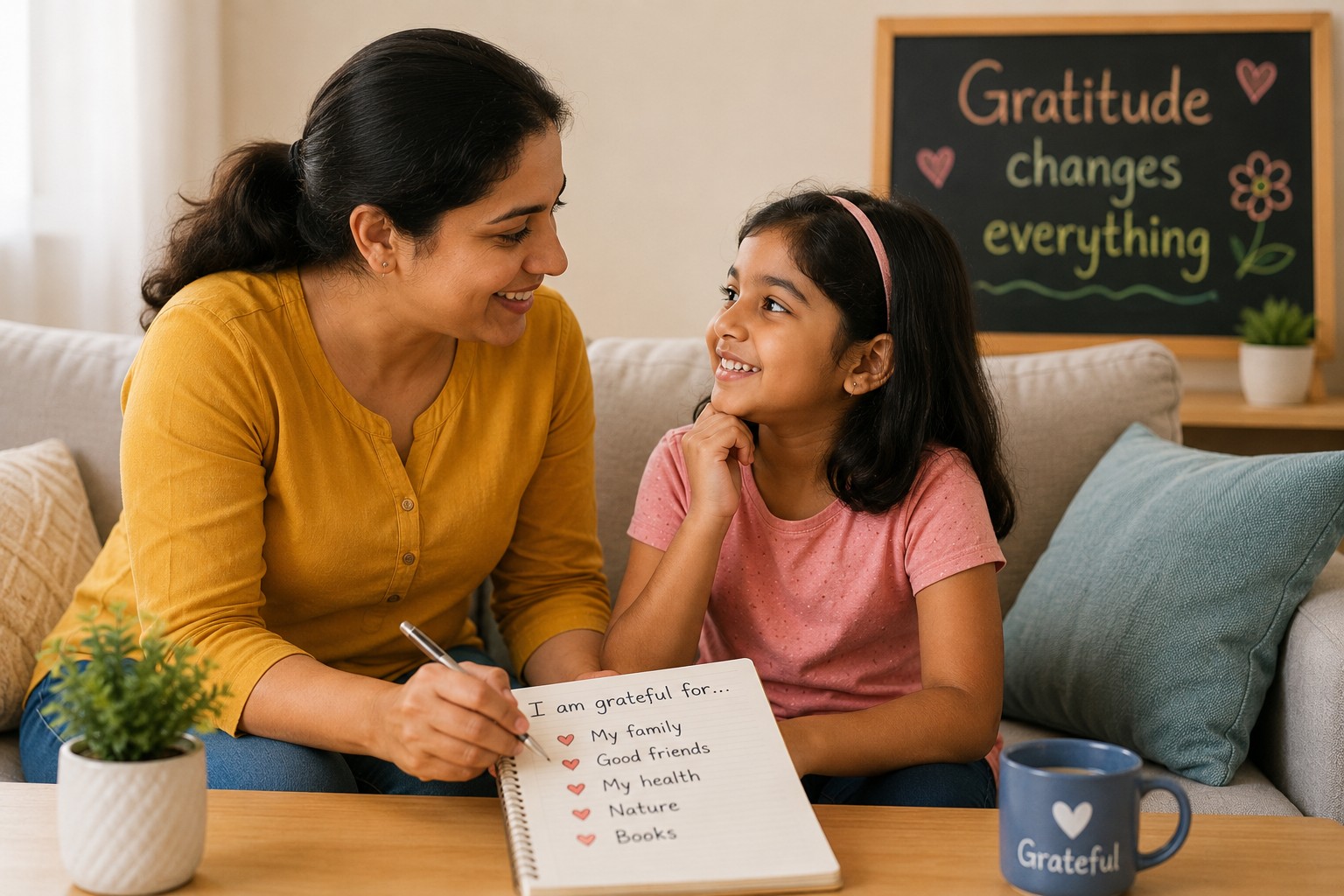
Counting blessings, done briefly and consistently. The core practice from Froh's original research is almost disarmingly simple: regularly naming a small number of specific things you're grateful for. The consistency matters more than the depth — a brief, repeated practice outperforms an occasional, elaborate one.
The gratitude letter. A classic positive psychology exercise, adapted for kids: help your child write a letter to someone who did something meaningful for them, describing specifically what they did and how it affected them. Where possible, having the child read it aloud to the person in person tends to produce a noticeably stronger emotional effect than simply handing over a written note — though even the writing alone has real value.
Specificity coaching. Research on children's gratitude development has found that younger children (roughly ages 7–10) tend toward what researchers call "concrete gratitude" — focusing on tangible reciprocation ("I should give them a book back") rather than genuinely considering what the giver actually wanted or intended. Gently coaching a child toward more specific, person-centered gratitude — "what do you think it meant to them to help you?" — builds a more mature form of the skill over time, rather than a transactional one.
Gratitude visualization. Related research has found that setting aside a few minutes to actually visualize and write about a positive experience — not just list it quickly — produces stronger, longer-lasting positive mood effects than a rushed version of the same exercise. Slowing down for even a few extra minutes appears to matter.
Modeling it yourself, specifically. Naming your own gratitude out loud, with real specificity — not "I'm grateful for my family" but "I'm really grateful my colleague covered for me today when I was running late" — teaches the skill through demonstration far more effectively than instructing a child to do it in the abstract.
Age-Appropriate Application
Ages 5–7: Keep it concrete and visual — a simple "one good thing today" habit, perhaps drawn rather than written, works well at this age.
Ages 8–12: Introduce the gratitude letter and start coaching specificity — moving a child from "thanks for the gift" toward genuinely considering what the gesture meant and cost the giver.
Ages 13–16: This is where the materialism-counterweight effect becomes most relevant — a genuine, ongoing gratitude practice at this age may do real protective work against the comparison and consumption pressures that intensify during the teenage years specifically.
What to Do This Week
- Start a brief, consistent counting-blessings habit — even one specific thing, named daily — rather than waiting for a more elaborate practice you might not sustain.
- Help your child write one gratitude letter this month to someone specific, and if possible, have them deliver it in person rather than just writing it privately.
- Coach specificity the next time your child expresses thanks — ask "what do you think that meant to them?" instead of accepting a quick, generic "thanks."
Gratitude was never really about manners. The research suggests it's closer to a genuine psychological skill — one that quietly builds wellbeing, resilience, and a meaningful counterweight to the comparison culture that becomes especially loud during the teenage years.
Happy Sprout Action: Want your child building genuine gratitude and wellbeing skills through structured, research-backed practice? Register your child for a live Happy Sprout SEL class at happysproutminds.com — our curriculum weaves gratitude and reflection practices directly into every grade level, guided by a trained facilitator.
Future Starts Within.