A child refuses to sleep alone, so a parent stays in the room until they drift off. A child panics before a school presentation, so a parent calls the teacher to arrange an exemption. A child won't order their own food at a restaurant, so a parent quietly does it for them, every time, without a second thought.
Every one of these responses comes from real love. Yale Child Study Center researcher Eli Lebowitz has spent much of his career documenting something genuinely counterintuitive about this pattern: these accommodations, made with entirely good intentions, are one of the most consistent factors researchers have found in maintaining and worsening a child's anxiety over time.
What "Family Accommodation" Actually Means
Lebowitz's research defines family accommodation as the changes parents make to their own behaviour specifically to reduce a child's distress — avoiding situations that trigger anxiety, providing excessive reassurance, speaking on a child's behalf, or otherwise softening the world around an anxious child's specific fears.
Here's the finding worth sitting with directly: accommodation reliably reduces a child's distress in the short term, and just as reliably predicts worse anxiety severity, greater functional impairment, and poorer treatment outcomes over the longer term. It isn't that parents are doing something wrong by caring. It's that the instinct to protect an anxious child from every trigger inadvertently teaches the child's nervous system that the trigger really was too dangerous to face — reinforcing exactly the belief anxiety runs on.
The Program Built Around This Finding
Lebowitz and colleagues at Yale developed SPACE (Supportive Parenting for Anxious Childhood Emotions) — a treatment that, unusually, works entirely through the parents, without requiring the anxious child to participate in therapy sessions at all. The core mechanism is straightforward: parents learn to gradually reduce accommodating behaviours while simultaneously increasing genuine emotional support and validation.
A randomized controlled trial comparing SPACE directly to traditional child-focused cognitive-behavioural therapy (CBT) — widely considered the gold-standard treatment for childhood anxiety — found SPACE performed comparably, despite the child never needing to attend a single session. That's a striking result: changing how parents respond, on its own, produced outcomes on par with directly treating the anxious child.
Why This Matters Even If Your Child Isn't in Clinical Treatment
You don't need a diagnosed anxiety disorder for this research to be relevant. The underlying mechanism — accommodation offers short-term relief but reinforces long-term avoidance — applies to garden-variety childhood worries just as much as to clinical anxiety. A child who's mildly nervous about a new activity and is quietly allowed to skip it every single time is receiving the same reinforcement signal as a child with a diagnosed anxiety disorder receiving heavier accommodation.
The Key Distinction: Accommodation vs. Support
This is where the research gets genuinely nuanced, and where a lot of parenting advice oversimplifies into "stop coddling your child" — which misses the point entirely. The goal isn't to withdraw warmth or support. It's to separate emotional support from behavioural accommodation.
- Accommodation looks like: avoiding the trigger entirely, doing the anxiety-provoking task for the child, or providing constant reassurance that the feared outcome won't happen.
- Support looks like: validating the feeling genuinely ("I can see this feels really scary"), while still expecting the child to face the manageable version of the challenge.
A parent using SPACE's approach might say: "I know this feels really hard, and I believe you can do it. I'm not going to do it for you, but I'm right here." That sentence contains real warmth and zero accommodation — which is precisely the combination the research points to as most effective.
Practical Emotional Skills That Make the Biggest Difference
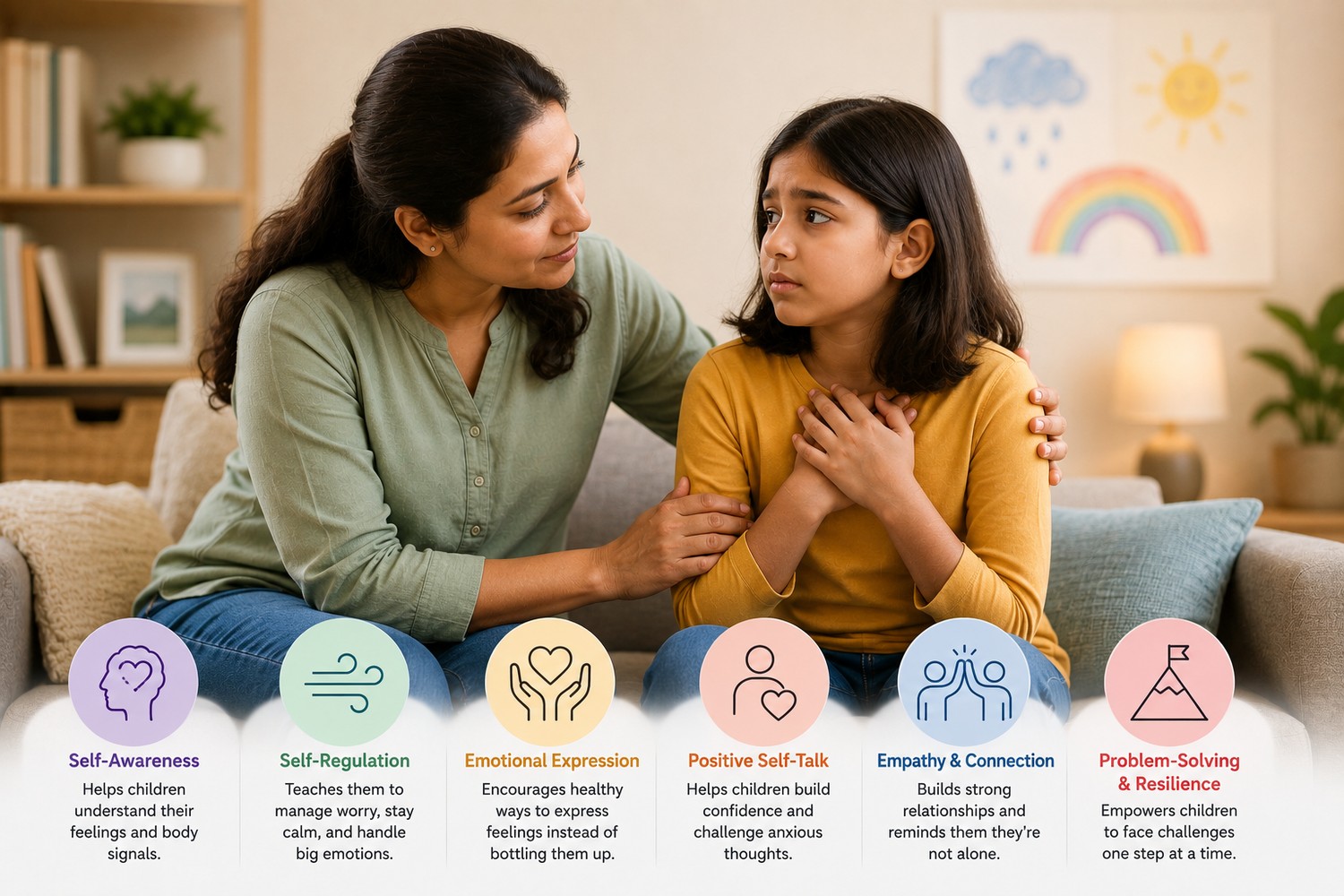
Naming the anxiety without following its instructions. Teaching a child to say "I'm feeling anxious right now" — full stop, without immediately following it with an escape plan — builds the self-awareness needed to eventually make a different choice than avoidance.
Graduated exposure, not sudden immersion. The core mechanism behind most effective anxiety treatment is gradual, manageable exposure to the feared situation — not overwhelming confrontation, and not permanent avoidance either. A child terrified of dogs doesn't need to pet a large one immediately; they might start by looking at pictures, then observing one from a distance, building up gradually.
A scheduled "worry time." A specific technique from cognitive-behavioural practice: designate a short, consistent daily window — ten minutes, same time each day — where a child is invited to voice every worry they're carrying. Outside that window, worries get gently redirected to "let's save that for worry time." This paradoxically reduces overall worry by giving anxious thoughts a contained, predictable outlet rather than letting them intrude constantly.
Coaching realistic probability, not blanket reassurance. Instead of "nothing bad will happen" (a promise that isn't actually true and that anxious kids often see through), try: "what do you think is the actual likelihood of that happening? What would you do if it did?" This builds a genuinely useful thinking skill rather than a comforting but ultimately hollow guarantee.
What to Do This Week
- Identify one specific accommodation you're currently making — an avoided situation, a task done on your child's behalf, a form of constant reassurance — and consider whether it's protecting your child or quietly reinforcing the anxiety.
- Practice the validation-without-accommodation sentence structure: "I know this feels hard, and I believe you can do it" — used consistently, even when it's harder than simply removing the trigger.
- Try scheduled worry time for one week if your child tends toward frequent, intrusive worries, and notice whether containing the worry to a specific window changes its overall grip on the rest of the day.
Helping a child with anxiety was never really about removing every hard thing from their path. The research points somewhere less intuitive and ultimately more effective: staying warmly present while gently, consistently expecting them to face what they can actually handle.
If your child's anxiety is significantly affecting daily functioning, please consult a mental health professional — the strategies here support everyday emotional skill-building, but they aren't a substitute for clinical treatment when it's genuinely needed.
Happy Sprout Action: Want your child building genuine anxiety-management skills — naming feelings, graduated confidence-building, realistic thinking — through structured, guided practice? Register your child for a live Happy Sprout SEL class at happysproutminds.com, guided by a trained facilitator.
Future Starts Within.