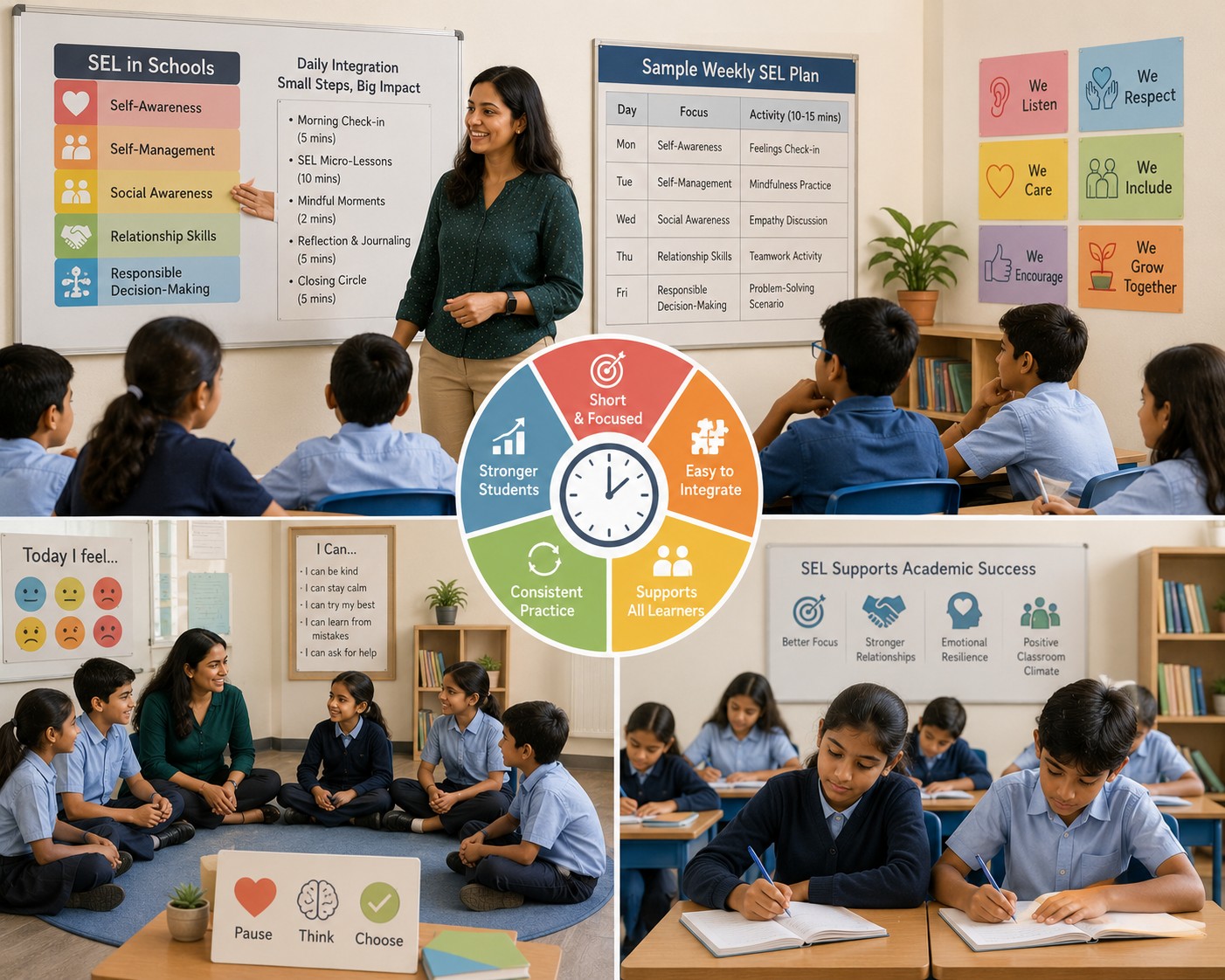
Here's the objection that kills more SEL initiatives before they even start: "We don't have room in the timetable." It's a reasonable concern from any principal juggling board requirements, exam prep, and an already-packed academic calendar. It's also based on a false assumption — that SEL requires a new, standalone period competing for the same finite hours as everything else.
It doesn't have to. Here's how schools actually implement SEL using time they already have.
The Three-Layer Model Most Schools Get Wrong
The Collaborative for Academic, Social, and Emotional Learning (CASEL) distinguishes between three distinct ways SEL can be delivered in a school — and most schools that struggle with implementation are trying to do all their SEL work through only one of the three, usually the most timetable-intensive one.
Layer 1: Explicit SEL instruction. A dedicated lesson or activity specifically teaching a social-emotional skill. This is the layer everyone pictures when they hear "SEL programme," and it's also the layer most likely to require new timetable space — which is exactly why it becomes the sticking point in the "we don't have room" conversation.
Layer 2: Integration into academic instruction. SEL skills taught through existing subjects, not alongside them — a literature discussion that explores a character's emotional decision-making, a history lesson that practises perspective-taking across historical viewpoints, a science lab structured around genuine collaboration and conflict resolution. This layer requires zero additional timetable time, because it's not new content — it's a different lens applied to content already being taught.
Layer 3: Schoolwide practices and routines. Small, structural moments — a consistent greeting at the classroom door, a brief check-in during existing homeroom or attendance time, a calm-corner option already available in every classroom. These cost minutes, not periods, and many schools already have unused structural moments — transitions, dismissal, attendance-taking — that can absorb this layer without touching the academic schedule at all.
The schools that struggle most with SEL "not fitting" are almost always trying to deliver everything through Layer 1 alone. The schools that implement successfully without calendar disruption spread the work across all three layers — leaning heavily on Layers 2 and 3, which cost little to no additional time, and reserving Layer 1 for a genuinely minimal, protected slot.
Where the "Free" Time Actually Is
Most schools already have structural moments that go unused for anything beyond logistics. A few worth auditing directly:
Homeroom or advisory period. Many schools already have 10–15 minutes of homeroom time used almost entirely for attendance and announcements. A two-minute feelings check-in or a brief values discussion fits inside time that already exists on the schedule.
Transition time. The few minutes between subjects or after recess are natural candidates for a sixty-second grounding routine — genuinely costs nothing pulled from instructional time, since it happens in a window that was already transitional, not academic.
Existing subject content. A maths word problem framed around a social scenario, a language class debate structured around perspective-taking, a group science project explicitly coached on collaboration skills — none of this adds new content. It reframes content that was being taught regardless.
Dismissal and arrival routines. A consistent closing ritual at the end of the day — one word for how the day felt — costs under a minute and requires no curriculum change at all.
Professional learning community time. Many schools already have regular teacher planning or PLC time. A recurring agenda item on embedding SEL into upcoming lesson plans uses existing staff time rather than requiring separate SEL-specific training sessions.
The Dosage vs. Integration Trade-Off
Here's a genuine tension worth naming honestly: standalone explicit SEL instruction (Layer 1) generally allows for more structured, sequenced skill-building than integration alone — which is part of why CASEL's own guidance for high-quality SEL programming emphasizes being Sequenced, Active, Focused, and Explicit (sometimes referred to by the acronym SAFE). A school relying entirely on Layers 2 and 3, with zero explicit instruction, risks SEL feeling diffuse and inconsistent rather than genuinely skill-building.
The realistic answer isn't choosing one layer over the others — it's finding the smallest viable dose of Layer 1 that still meets the sequenced, explicit bar, and letting Layers 2 and 3 carry the rest of the weight. A protected 15-minute weekly slot, done consistently and well, paired with daily integration and routine, tends to outperform either a large standalone SEL period implemented poorly, or a purely diffuse approach with no explicit instruction at all.
A Practical Implementation Sequence
Step 1: Audit existing structural time. Before adding anything, map homeroom, transitions, dismissal, and existing subject content for genuinely unused capacity — most schools find more available time than they expect once they look specifically for it.
Step 2: Start with Layer 3 — schoolwide routines. These cost the least and require the least staff training, making them the lowest-friction starting point. A consistent door greeting or check-in ritual can be implemented school-wide within weeks.
Step 3: Train teachers on Layer 2 integration using existing subject content, rather than asking them to learn an entirely separate SEL curriculum. A teacher who already knows how to teach the material they teach can usually be trained to add a perspective-taking or reflection layer to it far faster than they can be trained on a brand-new standalone programme.
Step 4: Protect a minimal, consistent Layer 1 slot — even 15 minutes weekly, sequenced and explicit — rather than either skipping explicit instruction entirely or trying to claim a large new block of time the calendar genuinely doesn't have.
Step 5: Measure lightly and iterate. A simple termly student survey or teacher feedback loop tells you whether the current mix of layers is actually working, without requiring a heavy, separate assessment infrastructure.
What School Leaders Should Do Next
- Audit your school's existing structural time this term — homeroom, transitions, dismissal — before assuming a new period is the only path to real implementation.
- Train teachers on Layer 2 integration first, using subjects they already teach, rather than starting with a request for entirely new curriculum time.
- Protect one small, consistent Layer 1 slot rather than either skipping explicit instruction or waiting for a full-period solution that may never fit the calendar.
SEL implementation was never actually blocked by the timetable. It was blocked by the assumption that it needed a new one.
Happy Sprout Action: Want a CASEL-aligned implementation plan built specifically around your school's existing schedule, not a new one? Explore Happy Sprout's school partnership programmes at happysproutminds.com — and if you're a parent reading this, you can register your own child for a live Happy Sprout SEL class at the same link.
Future Starts Within.