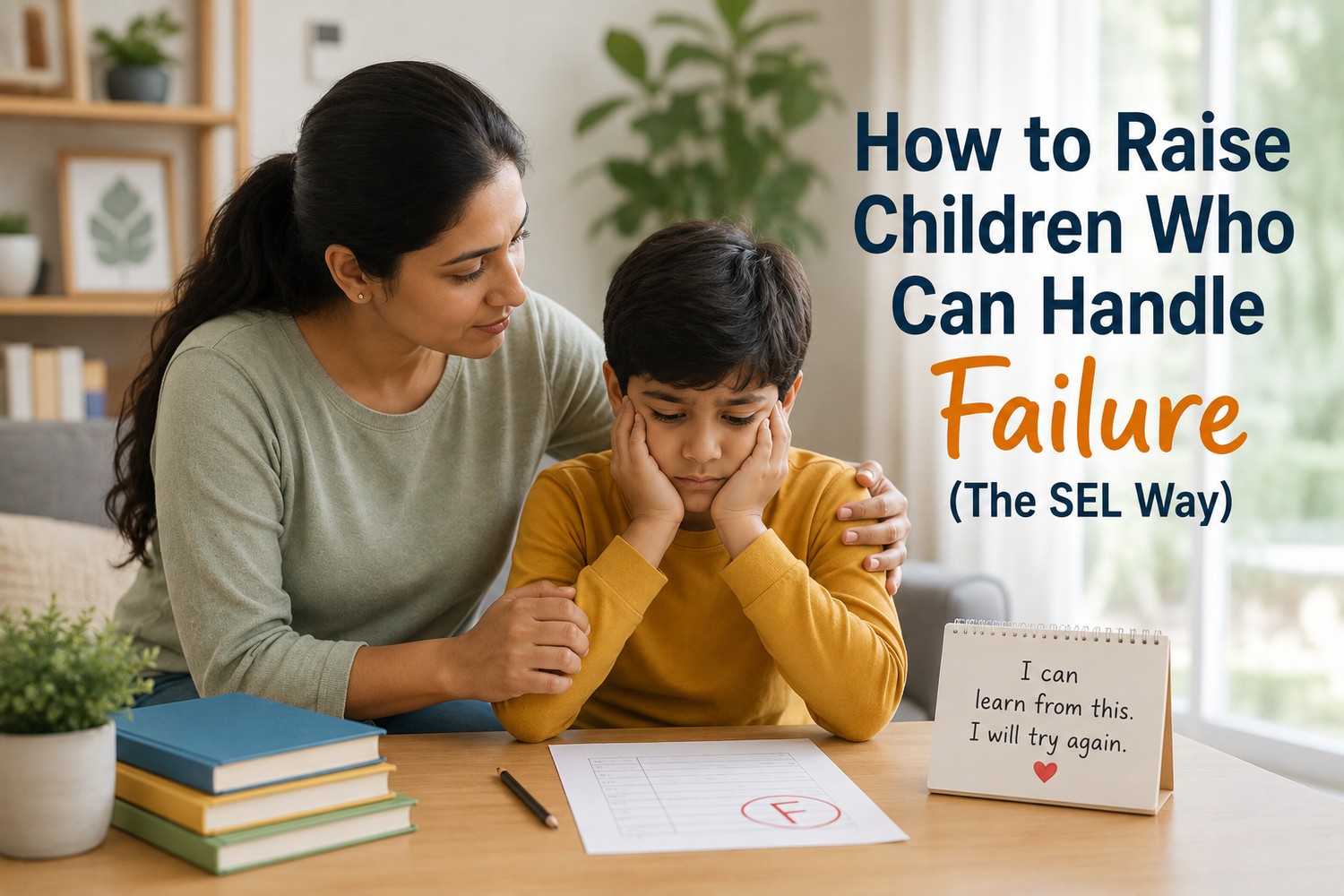
A child fails a test. One version of that child spirals into "I'm just bad at this," avoids the subject for weeks, and starts quietly negotiating their way out of anything that risks failing again. Another child, handed the identical bad grade, feels the sting for an afternoon and then asks what to try differently next time. Same event. Genuinely different outcome — and the difference has almost nothing to do with which child is smarter or more resilient by nature.
Researcher Kristin Neff's work on self-compassion offers one of the clearest explanations for what actually separates these two responses — and it isn't the thing most parenting advice reaches for first.
Why Self-Esteem Isn't the Right Tool for Handling Failure
Most instinctive parental responses to a child's failure aim at boosting self-esteem: "You're so smart, this one bad grade doesn't matter." It feels supportive. Neff's research suggests it's actually the less durable option.
Self-esteem is fundamentally tied to evaluation and comparison — it depends on the child continuing to feel good about themselves relative to some standard or to other people. That makes it inherently fragile under failure, precisely the moment it's needed most, because failure is exactly the experience that threatens the evaluation self-esteem depends on. In controlled experiments, Neff and colleague researchers found something specific: when people were given a genuine self-esteem boost after a failure, it did less to help them recover and try again than when they were coached toward self-compassion instead — treating themselves with the same kindness they'd offer a friend, recognizing that failure is part of shared human experience, and staying mindful rather than either spiraling or denying the disappointment.
Self-compassionate participants in this research were more likely to view their failure as a learning opportunity and more likely to try again afterward, compared to those who received a self-esteem boost or no intervention at all. Self-compassion isn't a softer, gentler version of self-esteem. It's a genuinely different mechanism — one that doesn't depend on the outcome going well to still function.
The Three Components of Self-Compassion (And How to Build Them in a Child)
Self-kindness instead of self-judgment. Teach your child the specific difference between "I failed this test" and "I'm bad at this." The first names an event. The second delivers a verdict. Coach the language shift directly: "That was a hard test. What happened?" rather than accepting "I'm just not smart" as the final word.
Common humanity instead of isolation. A failing child often feels uniquely, singularly bad at whatever just went wrong — as if nobody else has ever struggled with this exact thing. Sharing your own specific failures, told honestly rather than as a tidy lesson, directly counters this. "Everyone struggles" as an abstract statement lands far less than "here's a specific time I failed at something similar."
Mindfulness instead of over-identification. This means neither suppressing the disappointment ("it's fine, it doesn't matter") nor drowning in it. Naming the feeling accurately — "that felt really disappointing" — without either minimizing it or treating it as catastrophic, is the actual skill underneath this third component.
The Overparenting Trap: Why Some Kids Never Get the Practice
Here's a second, related problem worth naming directly, drawn from educator Jessica Lahey's widely discussed research and writing on overparenting: a growing pattern of well-meaning parents who rush forgotten assignments to school, challenge teachers over disappointing grades, and generally intervene to prevent their children from ever actually experiencing failure in the first place.
Lahey's central argument is worth sitting with: these interventions feel like love, but they function as sabotage — not because the parents don't care, but because a child who's never allowed to fail never gets the chance to build the actual skill of recovering from it. Self-compassion, like any skill, needs real practice to develop. A child protected from every disappointing grade, every lost game, every awkward social moment never gets the repetitions the skill requires.
The alternative Lahey and others describe isn't neglect — it's sometimes called autonomy-supportive parenting: being present, warm, and available, while deliberately not stepping in to prevent a manageable failure or to soften its natural consequences. The parent's job shifts from preventing the fall to helping the child actually get back up afterward.
What This Looks Like in Practice
When your child fails at something, resist the urge to fix it or minimize it immediately. Let the disappointment register first — "that's really hard" — before moving to any kind of solution or reassurance.
Model self-compassion yourself, out loud, when you fail at something. "I really messed that up. Everyone has days like this. Let me figure out what I'd do differently" teaches the three components directly, through demonstration rather than instruction.
Resist rescuing manageable failures. A forgotten assignment, a dropped ball, a disappointing test score are exactly the low-stakes opportunities a child needs to practise recovering from — stepping in to prevent the natural consequence removes the practice rep entirely.
Separate the event from the identity, every time, in your language. "That test was hard" instead of "you're bad at maths." This single linguistic habit, repeated consistently, is one of the most concrete ways to build the self-kindness component of self-compassion.
What to Do This Week
- The next time your child fails at something manageable, resist stepping in to fix it — let the natural consequence play out, and focus your energy on the recovery conversation afterward instead.
- Practice the language shift from verdict to event — catch yourself or your child saying "I'm bad at X" and gently offer "that was hard" instead.
- Share one of your own real failures with your child this week, specifically and honestly, rather than only presenting yourself as already having it figured out.
Raising a child who can handle failure was never about protecting them from it, and it was never really about boosting their self-esteem back up after it happens. It's about building a genuinely different skill — one that doesn't depend on things going well to still be there when they don't.
Happy Sprout Action: Want your child building genuine resilience and self-compassion skills through real, guided practice — not just reassurance after the fact? Register your child for a live Happy Sprout SEL class at happysproutminds.com — our curriculum is built around exactly this kind of skill-building, guided by a trained facilitator.
Future Starts Within.