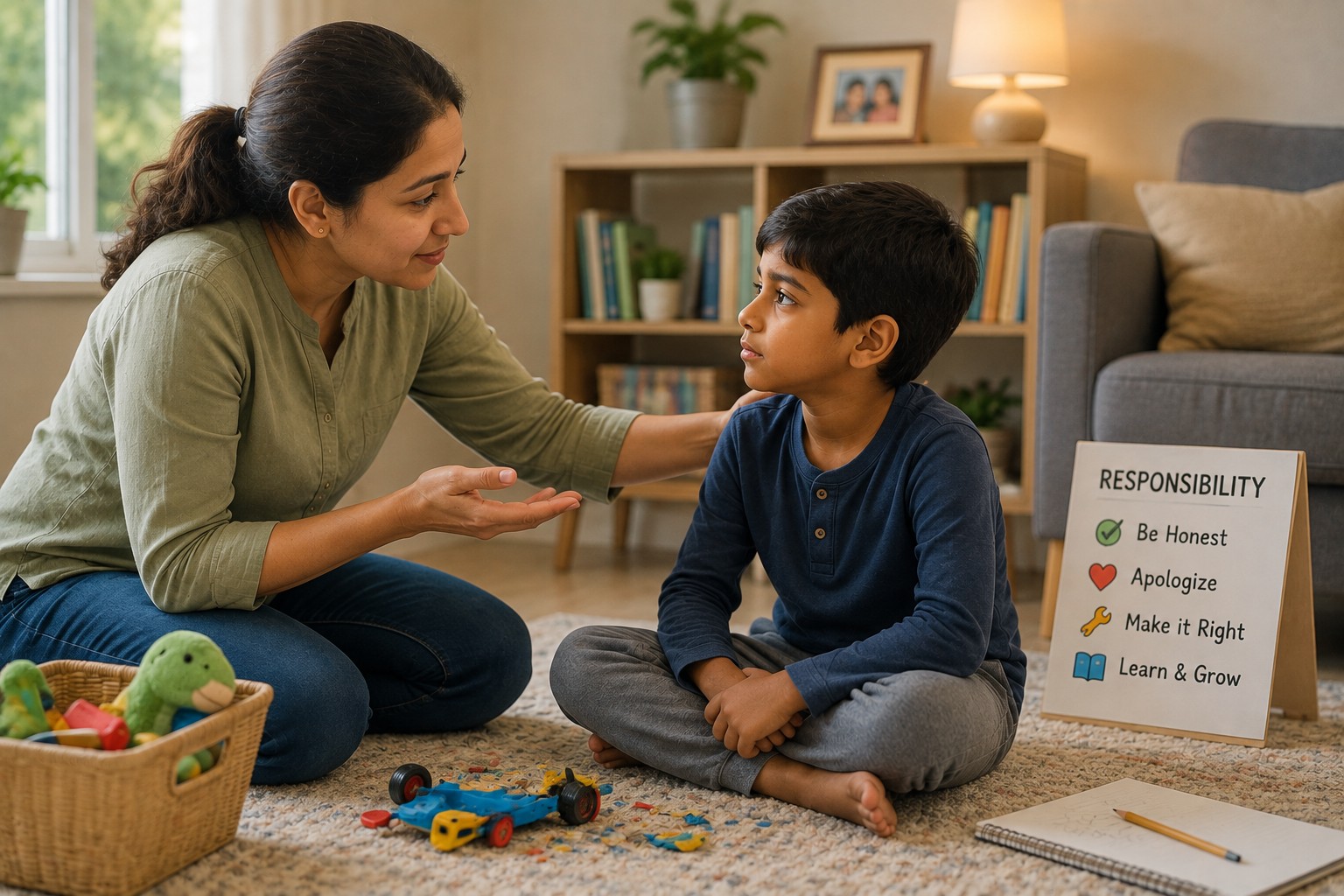
A child breaks something and immediately says "it wasn't my fault, it just fell." Another child, faced with the identical situation, says "I knocked it over, I should've been more careful." Psychologist Julian Rotter's foundational research on locus of control — first published in 1966 and cited in thousands of studies since — offers a specific, testable explanation for that difference: people vary in whether they believe outcomes are contingent on their own behaviour (an internal locus of control) or on chance, fate, or forces outside their control (an external locus of control) — and this single dimension predicts an enormous amount about how a person handles mistakes, including a child's willingness to genuinely own one.
Why Some Kids Deflect and Others Own It
Here's the finding worth understanding directly: an external locus of control isn't simply a personality quirk — it's a learned expectancy, shaped substantially by early experience. Research tracing the antecedents of children's locus of control has found something genuinely useful for parents: children raised with consistent, contingent reinforcement (consequences that reliably follow from their actual behaviour, not from parental mood), age-appropriate autonomy, and a warm, supportive relationship tend to develop a stronger internal locus of control than children raised in less predictable or more controlling environments.
The mechanism makes intuitive sense once you see it stated plainly: a child only learns "my actions cause outcomes" if outcomes actually, reliably follow from their actions. A child whose consequences depend more on a parent's mood that day than on what the child actually did has less evidence, from lived experience, that responsibility and outcome are genuinely connected — which makes external blame a more natural, evidence-based conclusion for that child to draw, not simply a character flaw.
The Surprising Link Between Fixed Mindset and Refusing to Apologize
Here's a genuinely counterintuitive finding from psychologist Karina Schumann's research, conducted with Carol Dweck: people who believe personality and character are fixed traits — the same fixed mindset that shapes how a person handles academic failure — are measurably less likely to apologize or accept responsibility for wrongdoing. The logic, once explained, is striking: if you believe your moral character is a fixed, stable thing, then admitting fault feels like admitting something is permanently, fundamentally wrong with who you are — not a specific, correctable action.
This connects accountability directly to growth mindset in a way most parenting advice never makes explicit. A child who believes ability and character can grow and change has genuinely less to lose by admitting a mistake — the mistake is just information about something to improve, not a verdict on a fixed self. A child steeped in fixed-trait thinking has a real psychological incentive to deny, minimize, or blame externally, because acknowledging fault feels like conceding something permanent about who they are.
What Actually Makes an Apology Genuine
Researcher Ronald Lewicki and colleagues identified six components of an effective apology through controlled studies, and found something specific worth teaching directly to children: not all six components matter equally. The single most important element, by a clear margin, is acknowledgment of responsibility — genuinely saying "I did this, it was my fault" without hedging. The second most important is an offer of repair — a concrete step toward fixing what went wrong, not just words.
Expressions of regret, explanations, and promises to do better matter too, but they only read as genuine once responsibility has actually been acknowledged first. An apology that leads with "I'm sorry, but..." — followed by any justification — gets reclassified by the listener as a defense, not an apology, almost immediately. This is worth teaching to children explicitly: the word "but" after "I'm sorry" undoes almost everything that came before it.
How to Actually Build This
Make consequences consistent and connected to the actual behaviour, not to your mood or how tired you are that day. This is the single strongest lever the locus-of-control research points to — a child develops "my actions matter" from repeated, reliable evidence, not from being told it matters.
Grant genuine, age-appropriate autonomy. A child who's given real choices and allowed to experience the natural results of those choices builds a stronger sense that their behaviour drives outcomes than a child who's tightly controlled and rarely allowed to make an independent decision.
Model fault-acknowledgment without excuse-making yourself. "I was wrong to raise my voice, that wasn't fair" — full stop, no "but I was stressed" — teaches the exact apology structure the research points to as most effective, through direct demonstration.
Teach the "no but" rule for apologies explicitly. Help your child notice, in their own apologies, whether a justification is sneaking in after the "sorry" — and gently point out that the "but" undoes the apology's credibility.
Frame mistakes as fixable, not identity-defining, consistently — this directly counters the fixed-mindset barrier to apology Schumann and Dweck identified, making it genuinely easier for a child to admit fault without it feeling like a threat to who they are.
What to Do This Week
- Audit your own consequence-giving for consistency this week — notice whether your responses to the same behaviour vary based on your own mood, and work toward more predictable, behaviour-linked consequences.
- The next time your child apologizes, listen for a hidden "but" — gently point it out if it's there, without shaming, and ask them to try the sentence again without it.
- Model one genuine, excuse-free apology yourself this week, even for something small, so your child sees the real structure in action.
Raising a child who takes genuine responsibility was never about lecturing them into honesty. It's built the way the research actually points to: consistent consequences that teach "my actions matter," a growth-oriented sense that mistakes are fixable rather than identity-defining, and repeated, modeled practice with what a real apology — not just the word "sorry" — actually sounds like.
Happy Sprout Action: Want your child building genuine accountability and responsible decision-making skills through structured, guided practice? Register your child for a live Happy Sprout SEL class at happysproutminds.com, guided by a trained facilitator.
Future Starts Within.