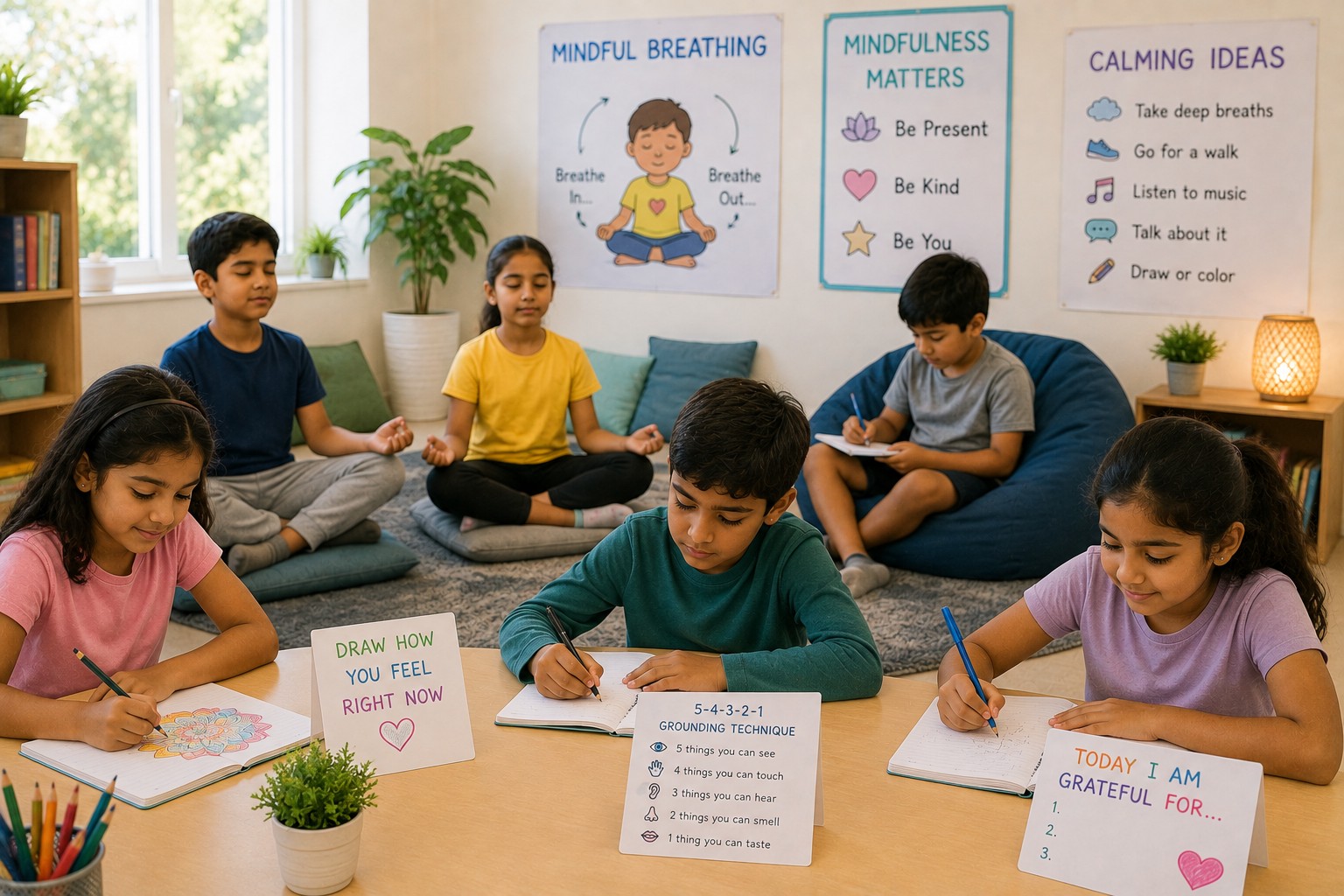
A teacher once told me about a boy in her class who, whenever he got frustrated with his work, would put his head down on the desk and refuse to move. Nothing she said reached him. One day, almost by accident, she crouched next to him and said, "Let's just breathe together for a minute. In for four, out for four." No talking, no fixing, just counting breaths side by side. Ninety seconds later, he lifted his head and picked his pencil back up, on his own.
She hadn't solved the maths problem for him. She hadn't even talked about what was wrong. She'd just given his nervous system a minute to catch up with itself — which, it turns out, is most of what he actually needed.
That's mindfulness for children in its simplest, least mystical form. Not incense and silence, not something only monks or yoga teachers do. Just the practice of noticing what's happening right now — in the body, in the breath, in the room — instead of being swept along by it.
What is mindfulness for children?
Mindfulness is the skill of paying attention to the present moment, on purpose, without immediately judging or trying to fix what you notice. For an adult, that might mean noticing tension in your shoulders during a stressful meeting. For a child, it's usually simpler and more physical: noticing that their heart is racing before a test, noticing their breath, noticing the five things they can see in the room right now instead of the argument they just had with their sibling.
It isn't about clearing the mind or achieving some blank, calm state — that's a myth even for adult practitioners, let alone for a seven-year-old who's just been told to sit still. Mindfulness activities for kids are really just repeated, playful practice at noticing — because noticing, it turns out, is the first step before a child can do anything useful with a big feeling. You can't calm down from a place you haven't noticed you're in.
Why does mindfulness matter for children?
Kids today are dealing with a genuinely fuller plate than a lot of adults realize — academic pressure, social comparison amplified by screens, packed schedules, and, for many, very little unstructured downtime. Their nervous systems are still developing the wiring for self-regulation, which means the tools an adult might reach for automatically — take a breath, step back, reframe it — aren't yet built-in for most children. They have to be taught, the same way reading or riding a bike is taught.
That's where the benefits of mindfulness for children show up most clearly: better focus during schoolwork, fewer emotional flare-ups that spiral out of control, and — maybe most importantly — a genuine tool a child can reach for themselves, rather than needing an adult to rescue every hard moment. A child who can take three slow breaths before a spelling test is a child who needs less rescuing, not more supervision.
How does mindfulness actually work for kids?
The mechanism is more physical than most people expect. When a child gets upset, their body shifts into a stress response — faster heart rate, shallower breathing, a flood of stress hormones that make it genuinely harder to think clearly. This isn't a character flaw or bad behaviour; it's biology. Simple mindfulness practices, especially slow breathing, work by directly signalling to the nervous system that it's safe to stand down — which is why a breathing exercise can calm a child down even when nobody has "solved" whatever upset them in the first place.
With repeated practice, this shifts from something a child needs a reminder for to something they reach for on their own. That's really the whole arc of teaching mindfulness to children: start with an adult prompting the practice in calm moments, and over time, the child starts to notice their own rising stress and use the tool without being told to.
This is why mindfulness exercises for the classroom work best woven into the ordinary rhythm of the day — a minute after recess, a minute before a test — rather than saved for a single "mindfulness lesson" once a week. Like any skill, it strengthens with frequent, brief use far more than with occasional, lengthy sessions.
What does research say about mindfulness for children?
The evidence base here has grown substantially over the past decade. Studies of mindfulness programs in schools consistently report improvements in attention, emotional regulation, and classroom behaviour, with some of the clearest effects showing up in children who struggled most with focus or emotional control to begin with — meaning the kids who need it most tend to benefit the most.
Research specifically looking at children with attention and behavioural challenges has found that structured mindfulness practice, done consistently, is associated with measurable reductions in stress reactivity and improvements in self-reported calm, alongside benefits for the parents who practice alongside them — mindfulness training aimed at the whole family tends to outperform training aimed at the child alone.
There's also a growing body of work on the neuroscience: regular mindfulness practice is linked to changes in how the brain's stress-response and attention systems communicate with each other, essentially strengthening the "brakes" a child can apply to a rising emotional reaction. None of this requires years of practice to start showing benefit — even brief, consistent practice over a few weeks shows measurable change in mood and self-regulation in children.
Common mistakes with mindfulness for children
Treating it as punishment or a consequence. "Go sit and breathe" delivered as a scolding teaches a child to associate mindfulness with being in trouble, not with a tool they'd choose to use themselves.
Only introducing it during a crisis. Like any skill, mindfulness is far easier to learn in a calm moment than in the middle of a meltdown. A child who's never practiced breathing exercises when calm won't reliably reach for one when upset.
Expecting stillness and silence right away. Adult mindfulness imagery — eyes closed, cross-legged, silent — doesn't map onto how most children actually engage. Wiggling, giggling, and short attention spans during a mindfulness activity aren't signs of failure; they're normal for the age group.
Making sessions too long. A ninety-second breathing exercise lands far better with most children than a ten-minute guided meditation. Length isn't what makes it effective — consistency is.
Using the same activity every time until it goes stale. Kids disengage from anything that becomes rote. A small rotating set of activities keeps the practice fresh and something they'll actually want to do.
Expert recommendations for teaching mindfulness to children
Keep sessions short — 1 to 3 minutes for younger children, up to 5 for older ones. Brief and frequent beats long and rare, every time.
Practice during calm moments, not just difficult ones, so the skill is already familiar when it's genuinely needed.
Use concrete, physical anchors — a hand on the belly to feel it rise and fall, a stuffed animal riding the breath — rather than abstract instructions like "clear your mind," which mean very little to a young child.
Model it yourself, out loud. A parent or teacher saying "I'm feeling rushed, let's take three breaths together before we start" teaches more than any standalone lesson on mindfulness.
Build it into existing transitions — after recess, before a test, at the start of circle time — rather than treating it as a separate, additional activity competing for time.
Let go of the need for stillness. Movement-based mindfulness (mindful walking, stretching) works just as well as seated practice for many children, especially younger or more energetic ones.
Real-world examples of mindfulness for children in action
In the classroom: A Grade 2 teacher started every day with a one-minute "belly breathing" routine — hands on stomachs, in for four counts, out for four. Within a few weeks, she noticed students starting to use the same slow breathing on their own before tricky tasks, without being prompted, simply because the routine had become familiar rather than novel.
At home: A mother of an anxious eight-year-old introduced a "five senses check" during car rides to school, where they'd take turns naming one thing they could see, hear, smell, and feel. What started as a way to pass the drive became her daughter's go-to tool for calming pre-test nerves, entirely unprompted, months later.
Before a stressful event: A basketball coach began having his under-12 team take three slow breaths together in a huddle before free throws during matches. Several players later told him it was the only part of the pre-shot routine that actually helped — not because it changed their technique, but because it gave their nervous system a moment to settle before the pressure hit.
10 mindfulness activities for children
1. Belly Breathing. Lie down or sit with a hand (or a small stuffed animal) on the belly. Breathe in slowly for four counts, watching the hand or toy rise, then out for four counts as it falls. Works for almost any age and needs zero materials.
2. The Five Senses Check. Pause and name one thing you can see, hear, smell, feel, and (if appropriate) taste, right now. Anchors attention in the present moment — great for car rides, waiting rooms, or right before something stressful.
3. Mindful Walking. Walk slowly and deliberately, paying attention to how each foot feels touching the ground. Works especially well for children who find sitting still difficult — the movement itself becomes the anchor.
4. The Glitter Jar. Fill a clear jar with water and a spoonful of glitter glue. Shake it and watch the glitter swirl, explaining that this is what thoughts look like when we're upset. Watch together as it settles, and talk about how the mind settles the same way, given a moment.
5. Balloon Breathing. Imagine the belly is a balloon. Breathe in slowly to "inflate" it, then breathe out slowly to "deflate" it, using hands to mime the balloon growing and shrinking. A playful, physical variation on belly breathing that younger kids especially enjoy.
6. The Body Scan (Shortened). Lying down, guide attention slowly from toes to head, pausing briefly at each part: "How do your feet feel? Your legs? Your tummy?" Keep it under two minutes for younger children — the goal is noticing, not achieving stillness.
7. Mindful Eating. Give a child a single raisin, small piece of fruit, or snack, and ask them to look at it, smell it, and eat it slowly, noticing the texture and taste before swallowing. Surprisingly effective at teaching present-moment attention through something every child already enjoys — eating.
8. Gratitude Rocks. Find or paint a few small stones, each one representing something the child is grateful for. Keep them in a pocket or on a windowsill as a physical reminder to pause and notice good things, not just difficult ones.
9. The Feelings Weather Check. Pause and ask: "What's the weather like inside you right now — sunny, stormy, foggy?" A gentle, non-verbal-friendly way to build the habit of noticing an internal state without needing to explain it in detail.
10. Mindful Listening. Ring a bell, chime, or even tap a glass, and ask the child to raise their hand the moment they can no longer hear the sound at all. Trains sustained attention in a way that feels like a game rather than an instruction to "focus."
Every one of these takes under five minutes, needs little to no equipment, and works equally well woven into a classroom routine or a bedtime one.
What should you do next?
Pick one activity from the list — not all ten — and try it at the same time each day for two weeks before adding another. A predictable moment matters more than a perfect activity:
If your child struggles with anxiety or big reactions: start with Belly Breathing or the Five Senses Check — both are portable enough to use anywhere, including in the moment something stressful happens.
If you're a teacher looking for something classroom-friendly: the Feelings Weather Check or Mindful Listening fit easily into an existing transition, like the start of class or after recess.
If your child finds sitting still difficult: start with Mindful Walking instead of a seated practice — movement can be just as mindful as stillness.
Mindfulness for children isn't about producing calm, quiet kids who never get upset. It's about giving them a tool they can reach for themselves, so a hard moment doesn't have to turn into a lost hour — at school, at home, or anywhere in between.
That's the same principle behind everything we build at Happy Sprout: small, consistent practices, repeated often enough to become second nature, not a single big lesson that's expected to do all the work.
Future Starts Within.