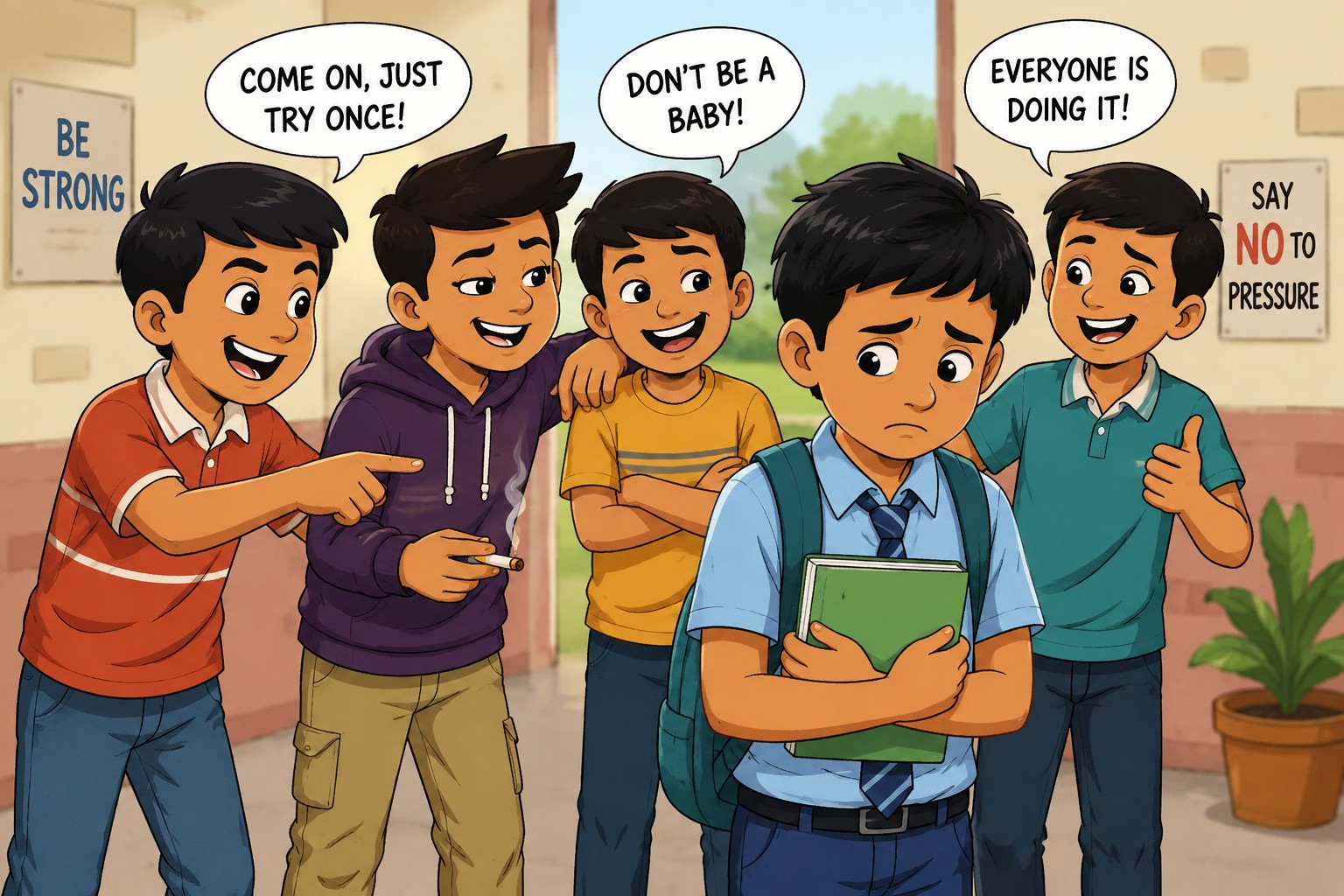
Here's the reframe every parent of a teenager needs: your teen isn't weak for caving to peer pressure. Their brain is, quite literally, wired to prioritise peer approval above almost everything else — including your authority in the moment.
A 2011 fMRI study out of Temple University (Chein, Albert, O'Brien, Uckert, and Steinberg, published in Developmental Science) found something striking: the mere presence of peers measurably activated reward-related regions of the adolescent brain — specifically the ventral striatum and orbitofrontal cortex — in a way that predicted riskier decision-making. Adults in the same study showed no such effect. Only the teenage brain lit up that way.
But here's the good news buried in the same research: SEL can rewire the response. Let's get into how.
The Adolescent Brain: Why Peer Approval Feels Like Survival
During adolescence, the brain goes through its second major pruning phase. The prefrontal cortex — the seat of rational decision-making — is still under construction. Meanwhile, the limbic system, responsible for emotion and reward, is running in overdrive.
Here's the part that reframes everything: being excluded from a peer group activates some of the same brain regions involved in processing physical pain. For a teenager, social belonging isn't a nice-to-have. Neurologically, it functions closer to survival.
Once you understand that, "just say no" starts to sound like exactly the kind of advice that was never going to work. You're not fighting a bad decision. You're fighting a brain doing precisely what evolution built it to do at that age.
3 Types of Peer Pressure Indian Teens Face Specifically
1. Academic pressure from peers. Being mocked for studying hard, or pressured to share answers, copy homework, or deliberately underperform just to fit in socially. In a culture that already runs hot on academic competition, this particular pressure cuts in a genuinely confusing direction.
2. Social media performance pressure. Pressure to present a curated, "cool" identity on Instagram and YouTube — one that may directly conflict with a teen's actual values or family culture. This pressure is nearly constant, unlike the classroom or the playground, because the phone never really switches off.
3. Risk-taking pressure. Pressure to try substances, engage in risky behaviour, or adopt anti-authority attitudes as a form of social currency — the classic version most parents already worry about, and for good reason.
How Values Clarification Acts as a Shield
Here's one of the more consistent findings in SEL research: adolescents with clearly articulated personal values show significantly stronger resistance to negative peer pressure.
The mechanism is straightforward. When a teen genuinely knows what they stand for, they have a fixed reference point to return to the moment pressure hits — something more stable than the shifting social dynamics of the room they're standing in. Values clarification exercises — actually identifying and ranking core personal values, not just being told to "have good values" — are among the highest-impact interventions available for teenage decision-making, precisely because they build that reference point in advance, long before it's needed under pressure.
Scripts Your Teen Can Actually Use to Say No (Without Social Death)
Knowing your values helps. Having an actual line ready to say out loud helps more. A few that work because they don't require justification:
- "I'm good, thanks — not really my thing." No explanation required. The confidence itself is the message.
- "I've got a thing with my family tonight." Uses an external constraint, which removes the whole conversation from personal judgment.
- "I don't do that anymore." The past tense implies a reason without ever having to elaborate on it.
- "My parents would kill me" — used strategically. This one works precisely because it puts the "blame" on an authority figure elsewhere, protecting your teen's social standing while still giving a hard no.
Practice these out loud at home before they're ever needed. A line rehearsed in a calm kitchen conversation comes out far more naturally under real pressure than one a teen is inventing on the spot.
What Parents Should Actually Do Next
- This week, have one values clarification conversation — not a lecture, a genuine two-way discussion about what actually matters to your teen and why.
- Practice one or two of the scripts above together, out loud, so they're already familiar before your teen needs them for real.
- Talk openly about the biology — telling your teen directly that their brain is wired this way at this age (not that something's wrong with them) often reduces shame and opens the door to a more honest conversation about the pressure they're actually facing.
Peer pressure was never going to be solved with a single stern conversation. It's solved the way most real skills are — with clear values, practised language, and a parent who understands the biology well enough not to take the struggle personally.
Happy Sprout Action: Want your teen to build these exact skills with structured, expert-led guidance instead of figuring it out alone? Register your child for a live Happy Sprout SEL class at happysproutminds.com — our Grade 9 and 10 curriculum includes a full Peer Pressure and Values unit with role-play scenarios and values clarification work, guided by a trained facilitator.
Future Starts Within.