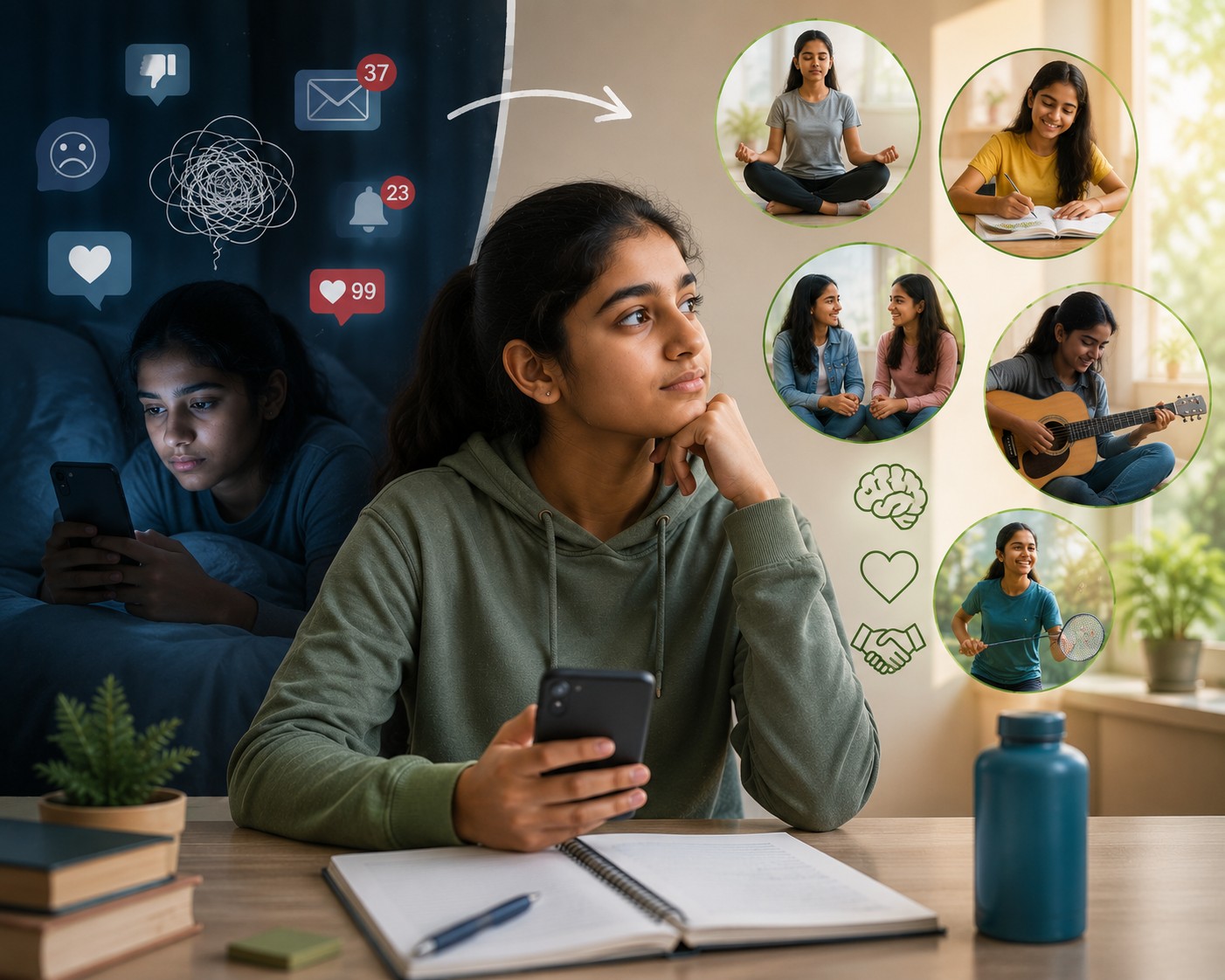
Here's the question almost every parenting article about screens asks: "How much screen time is too much for my child?"
Here's the question the research suggests is actually more important, and almost nobody asks it: "How much am I on my phone while I'm supposed to be with my child?"
Both matter. But one has a much stronger, more consistent evidence base than the other — and it's not the one most parenting advice focuses on.
Two Different Questions, Often Confused
Most conversations about "screens and kids" actually collapse two genuinely separate research questions into one:
- Does a child's own screen use affect their emotional and social development?
- Does a parent's screen use, during time with their child, affect that child's emotional and social development?
These have different evidence bases, different strength of findings, and — importantly — different practical solutions. Treating them as one issue is part of why screen time advice often feels contradictory or overwhelming. Let's take them one at a time.
What the Research on Children's Own Screen Use Actually Shows
Here's the honest state of the evidence: it's more nuanced, and more contested, than most headlines suggest.
The displacement hypothesis — the idea that screen time displaces the face-to-face social interaction children need to practise reading cues, taking turns, and managing conflict — has reasonable support, particularly for very young children whose social skills develop primarily through live, responsive interaction rather than passive content consumption.
But the research consistently finds that quality and context matter more than raw hours. A child watching a show alone, passively, for two hours is a different experience than a child watching the same show while a parent occasionally comments, asks questions, or connects it to real life — often called "co-viewing." Interactive video calls with a relative, which involve real back-and-forth responsiveness, appear to function quite differently from passive video content, even though both count as "screen time" in a simple hour count.
On social media specifically, particularly for teenagers, the research is genuinely more contested than either side of the public debate usually admits. Some researchers, notably in Jonathan Haidt's widely discussed work, argue for a strong causal link between smartphone and social media use and rising rates of teen anxiety and depression. Other researchers, including psychologist Candice Odgers and colleagues, have pushed back — arguing the evidence is largely correlational, that effect sizes in the underlying studies are often small, and that the causal story is far less settled than the popular narrative suggests. The honest position, as of the current evidence, is that this specific question — social media and teen mental health — remains a genuinely live scientific debate, not a closed case in either direction.
What the Research on Parental Screen Use Actually Shows — And Why It's Stronger
Here's where the evidence gets considerably more solid, and where most screen time conversations quietly leave a gap: research on "technoference" — a term coined by researchers Brandon McDaniel and Jenny Radesky to describe everyday interruptions in parent-child interaction caused by a parent's own device use.
The findings here are more consistent and more replicated than the child-screen-time debate: parental phone use during time with a child reduces responsiveness, slows reaction time to a child's needs, and is associated with higher rates of child behaviour problems over time, tracked in longitudinal studies. Observational research has found that when a parent's attention is absorbed by a phone, infants and young children fuss more and become harder to settle — likely because a core mechanism of early emotional development, responsive back-and-forth interaction between parent and child, gets quietly interrupted, sometimes dozens of times across an ordinary day.
This is the part of the screen time conversation most parenting advice skips entirely — not because it's less important, but because it's less comfortable to examine than a child's own device use.
What to Actually Do About It
Given the different strength of evidence, the practical response looks different for each question.
For your child's own screen use:
- Favour interactive over passive content where possible — co-viewing, video calls with relatives, or content that prompts a response, rather than hours of solo passive watching.
- Don't panic over total hours alone — the research increasingly suggests context and content quality matter as much as, or more than, a raw number.
- For social media specifically with teens, stay engaged rather than either banning outright or ignoring entirely — given the genuine scientific uncertainty, an ongoing, non-judgmental conversation about their experience of it tends to serve better than a fixed rule imposed without discussion.
For your own screen use around your child — the stronger, more actionable finding:
- Create phone-free windows specifically for connection — the first few minutes after school pickup, mealtimes, and bedtime are high-value moments where technoference research suggests your presence matters most.
- Notice your own reflexive phone-checking, particularly during your child's attempts to get your attention — the research specifically flags this pattern of interrupted responsiveness as the mechanism of concern, not phone use in the abstract.
- Model what you're asking of your child. A household rule about screens that only applies to the child, while the parent remains constantly available on their own phone, teaches a confusing double standard that undercuts the entire goal.
What to Do This Week
- Pick one connection window — pickup, dinner, or bedtime — and make it phone-free, starting this week, before addressing your child's own screen habits at all.
- Notice, honestly, how often your phone interrupts a moment your child is trying to get your attention. Awareness of the pattern is the first step the technoference research suggests actually changes it.
- If your teen is active on social media, start an ongoing conversation rather than a single rule-setting talk — given the genuine uncertainty in the research, staying curious and involved serves better than either extreme.
The screen time conversation was never going to be solved with a single hour limit. The stronger, more actionable finding in the research isn't really about your child's screen at all — it's about what happens to your own attention, and how often it quietly leaves the room before you do.
Happy Sprout Action: Want your child building genuine social and emotional skills through real, guided interaction — not another screen? Register your child for a live Happy Sprout SEL class at happysproutminds.com and give them structured, face-to-face practice with a trained facilitator.
Future Starts Within.