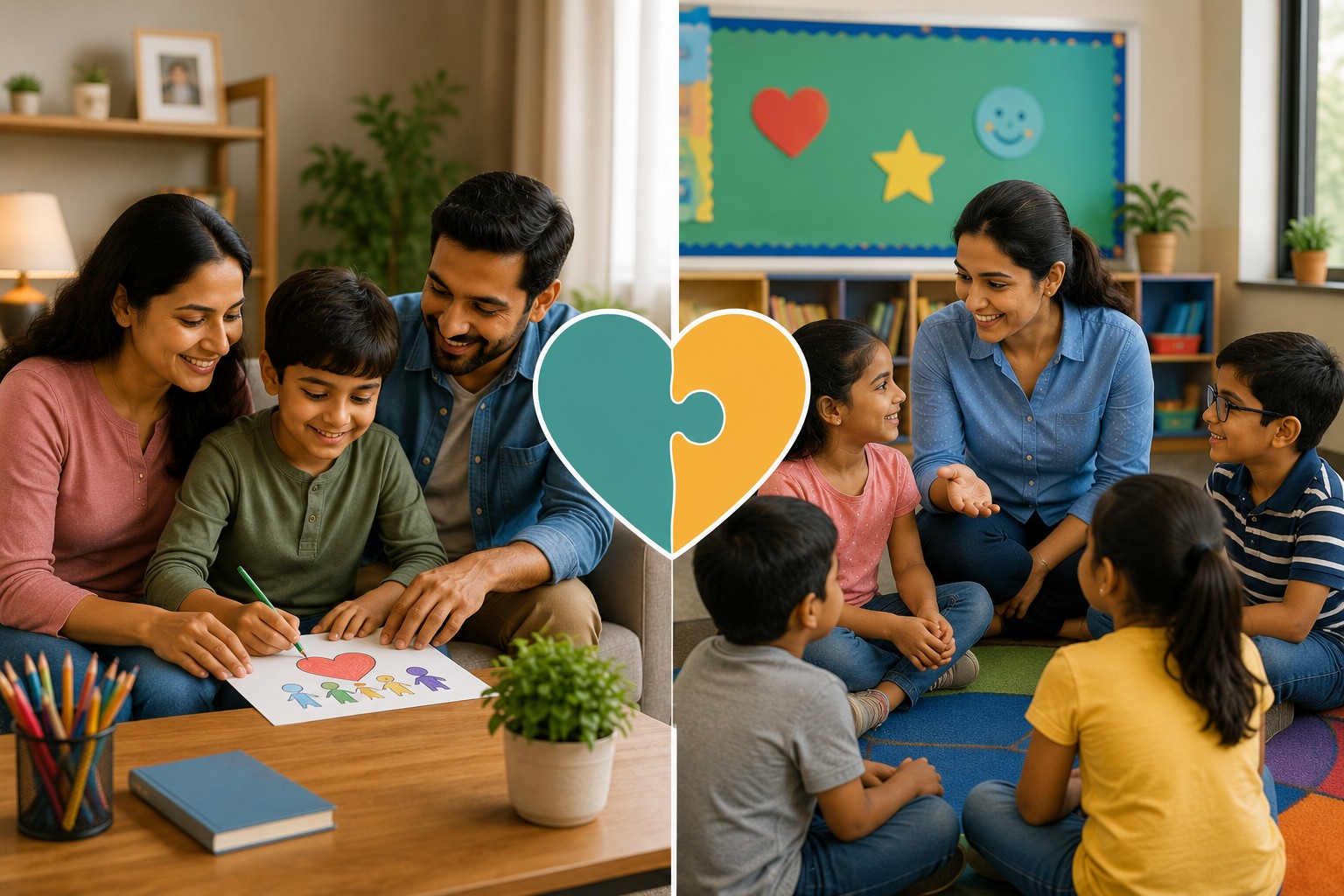
Developmental psychologist Urie Bronfenbrenner's influential ecological systems theory made an argument that's easy to state and genuinely underused in practice: a child's development doesn't just depend on what happens at home and what happens at school, treated as two separate boxes. It depends heavily on the connection between them. Bronfenbrenner called this connective layer the mesosystem — not a place a child inhabits, but the relationship between the places they inhabit.
Here's the practical translation for SEL specifically: a school teaching genuine emotional regulation skills, and a home reinforcing entirely different language and expectations around the same feelings, isn't giving a child twice the support. It's often giving them a confusing, conflicting signal that undermines both efforts.
Why the Connection Matters More Than Either Setting Alone
Bronfenbrenner's framework is explicit on this point: the strength and coherence of the connection between a child's microsystems — home and school being the two most significant for most children — has real, independent developmental consequences, separate from how good either setting is individually. A strong school SEL program and a warm, engaged home can still under-deliver for a child if the two settings are working from different playbooks the child has to constantly translate between.
This isn't about needing every value or approach to be identical — some healthy variation between home and school is normal and even useful. The real risk is contradiction, not variation: a school teaching a child to name and sit with a difficult feeling, paired with a home that consistently says "stop crying, you're fine," sends a genuinely conflicting message about whether the skill being taught at school is actually welcome anywhere else in the child's life.
Where Home and School SEL Most Commonly Diverge
Different vocabulary for the same skill. A school using a specific framework — "STOP-THINK-CHOOSE," a feelings wheel, a particular breathing technique — loses much of its power if a parent never learns or uses the same language at home. A child ends up managing two separate systems instead of one reinforced one.
Different responses to the same behaviour. A school that responds to a meltdown with a calm-down corner and co-regulation, paired with a home that responds to the same behaviour with immediate, harsher discipline, teaches a child that the same feeling gets treated as acceptable in one place and shameful in another — genuinely confusing, and often destabilizing.
Different levels of emotional openness. A school actively encouraging emotional expression, paired with a home culture where certain feelings are implicitly discouraged, creates a child who has to code-switch between two entirely different emotional norms — a real cognitive and emotional load most adults underestimate.
How to Actually Build the Connection
Ask the school directly what specific SEL language or framework they use, and adopt the same terms at home. If a teacher uses "the calm-down steps" or a specific breathing technique, using that exact phrase at home — rather than inventing your own version — reinforces one coherent system instead of two competing ones.
Treat parent-teacher communication as a genuine two-way SEL channel, not just an academic-progress check-in. A brief question like "what language do you use with the class when someone's upset?" opens a door most parent-teacher conversations never walk through.
When home and school approaches genuinely conflict, address it directly rather than letting the child absorb the contradiction silently. If a school's calm, non-punitive approach to a specific behaviour conflicts with a family's disciplinary values, that's worth a genuine conversation with the teacher — not something to simply let a child navigate as two separate, unreconciled rule sets.
Reinforce, don't duplicate. Home doesn't need to become a second classroom running the exact same curriculum — it needs to use compatible language and values, applied naturally to home-specific situations, rather than mechanically repeating school content.
Model the same emotional openness you'd want reflected back from school, and vice versa — if a school is actively building a culture where big feelings are safe to express, a home that quietly discourages the same thing is working against, not alongside, that effort.
What to Do This Week
- Ask your child's teacher one specific question about the SEL language or framework used in class, and start using the same terms at home this week.
- Notice one place where your home's response to a specific behaviour might genuinely conflict with what's being taught at school, and consider whether that's worth a direct conversation with the teacher.
- Use the same emotional vocabulary your child is learning at school in ordinary home conversations, so the language becomes one continuous thread rather than two separate systems.
SEL was never meant to live in two disconnected boxes, one at school and one at home, each hoping the other is doing its part. The research points somewhere more specific: the connection between the two is where a meaningful share of the real developmental benefit actually lives — and it's a connection most families and schools have simply never been asked to build deliberately.
Happy Sprout Action: Want SEL instruction genuinely designed to extend from the classroom into your home, with shared language and consistent reinforcement? Register your child for a live Happy Sprout SEL class at happysproutminds.com — our curriculum includes parent resources built to align directly with what's taught in each session.
Future Starts Within.