Here's the pitch for why this competency deserves your attention before any other: a child who genuinely knows their own strengths, triggers, values, and feelings never fully loses themselves to peer pressure, comparison, or the need for external validation.
Self-awareness is the inner compass. Every other emotional skill — regulation, empathy, decision-making — is calibrated against it. Get this one right, and the rest gets meaningfully easier to build.
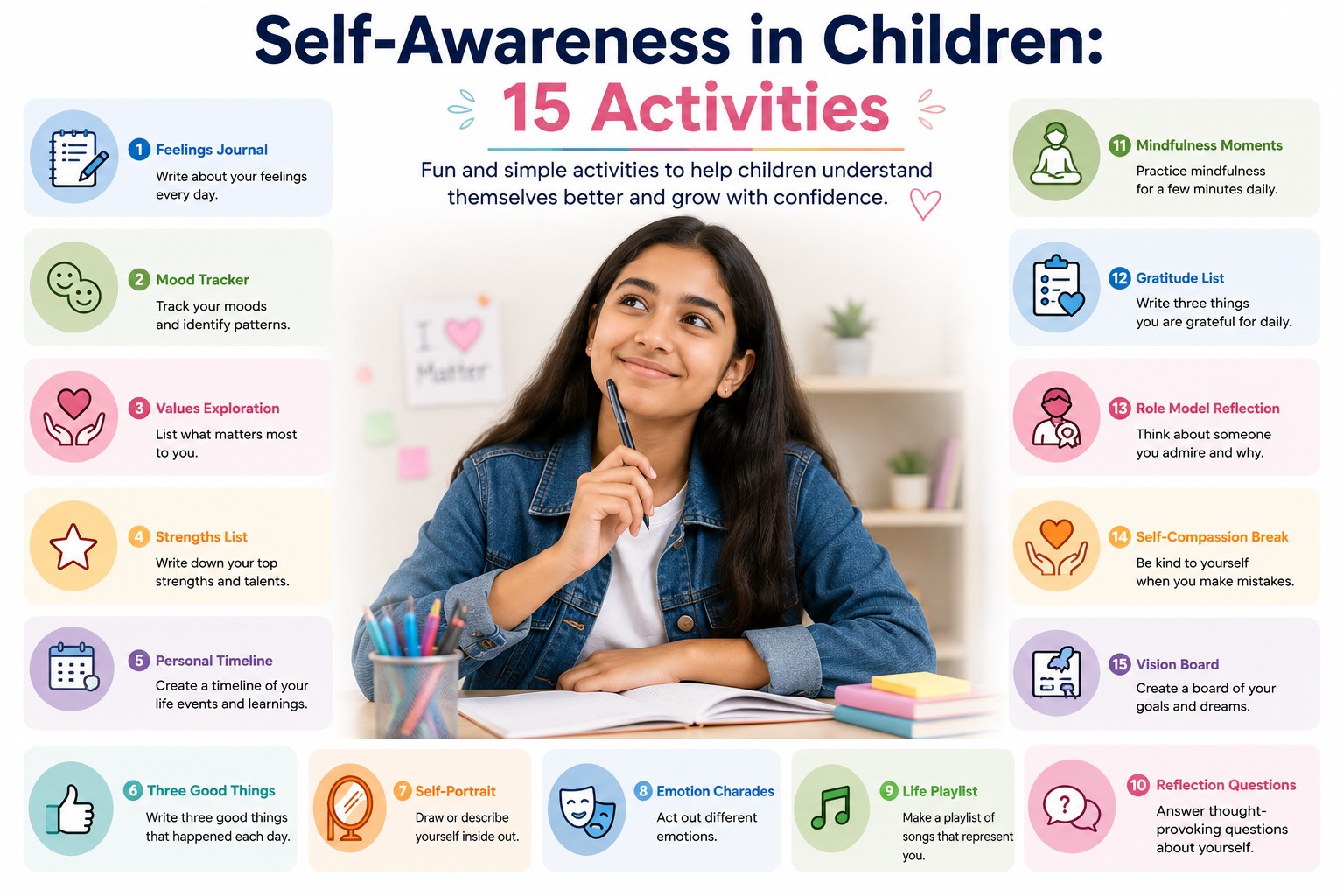
Here are 15 proven ways to build it, organised by age, so you can pick exactly where your child is right now instead of guessing.
Activities for Ages 6–8: Building the Foundation
1. The Emotion Wheel Check-In. Print a 64-emotion wheel and put it somewhere visible. Every morning, your child points to how they feel. Do this consistently, and their emotional vocabulary noticeably expands within a few weeks — moving well past "happy, sad, mad" into words like "nervous," "proud," "left out."
2. The Mirror Game. Stand together in front of a mirror. Take turns making an emotion face; the other person has to guess it. Kids genuinely love this one, and it quietly builds emotion recognition through play rather than instruction.
3. My Feelings Book. A handmade book where each page covers a different emotion, with a drawing and one sentence: "I feel ______ when ______." Simple, low-effort, and it becomes a keepsake your child can flip back through months later.
4. Strength Spotting. Each week, notice and name one specific strength your child demonstrated: "I noticed you stayed patient when your little sister interrupted your homework." Specificity matters here — a vague "good job" teaches nothing; a named, observed strength builds real self-concept.
5. The Body Scan. Ask, "Where do you feel worry in your body?" Teaching a child that emotions physically live somewhere — a tight chest, a knotted stomach — builds interoception, arguably the deepest layer of self-awareness, and one most adults never developed either.
Activities for Ages 9–12: Deepening Self-Understanding
6. The Values Card Sort. Give your child 20 value cards — honesty, adventure, kindness, achievement, and so on — and ask them to pick their top five. Then discuss why. The "why" conversation is where the real self-awareness happens, not the sorting itself.
7. Trigger Mapping. Help your child draw a simple map of their common triggers — specific situations, words, or events that tend to set off big emotions. Once a trigger has a name and a spot on a page, it stops feeling like it comes out of nowhere.
8. The Strength Inventory. Use the VIA Character Strengths survey (free online, with a validated youth version) to identify your child's top five character strengths with genuine psychological grounding behind it — not a guess, an actual measured result they can see themselves.
9. The Weekly Emotion Journal. Just two questions, once a week: "What was the strongest emotion I felt this week?" and "What caused it?" Low effort, high consistency — exactly the combination that makes a habit stick with a nine-year-old.
10. The "I Am" Poem. A ten-line poem where every line starts with "I am..." The instruction that makes this one work: focus on qualities, not roles or achievements. Not "I am a good student" — "I am curious," "I am someone who keeps trying."
Activities for Ages 13–16: Building Identity and Values
11. The Life Timeline. Map significant moments across their life on a simple timeline, then discuss what each one taught them about who they are. Teens are often surprised by the pattern that emerges once it's laid out visually.
12. The Personal Mission Statement. Guide your teen through writing a one-paragraph personal mission statement — what they stand for, what kind of person they want to be. It doesn't need to be permanent or perfect; the value is in the act of articulating it at all.
13. Feedback Mapping. Ask three trusted people — a parent, a friend, a teacher — the same single question: "What do you see as my greatest strength?" Then compare the answers together. Patterns across three different relationships carry a kind of weight that self-reflection alone can't match.
14. Decision Archaeology. Revisit a recent difficult decision together. What values actually drove it? What emotions were pulling in the background? What would they do differently now, with distance from the moment? This turns a single decision into a genuinely reusable self-awareness habit.
15. The Shadow Inventory. Ask: "What qualities do you most dislike in other people?" Often — not always, but often — those are qualities a person is quietly struggling with in themselves. This is a well-established reflective exercise rooted in Jungian psychology, and it lands surprisingly well with teens who are already deep in the work of figuring out who they are.
How to Actually Use This List
Fifteen activities is a lot to take in at once — don't try to run all of them this month. A more realistic approach:
- Match the activity to your child's actual age band, not the one you wish applied. A nine-year-old doesn't need a personal mission statement yet, and a fifteen-year-old has usually outgrown the emotion wheel.
- Pick one activity and run it consistently for two to three weeks before adding a second. Self-awareness builds through repetition, not variety.
- Revisit the same activity as your child ages. The Emotion Wheel at six becomes Trigger Mapping at ten becomes Decision Archaeology at fifteen — it's the same underlying skill, just growing more sophisticated alongside your child.
Self-awareness was never going to be built in a single conversation. It's built the way all fifteen of these activities work — a little, consistently, across years, until knowing themselves becomes second nature rather than something they have to work at.
Happy Sprout Action: Happy Sprout's Self-Awareness curriculum includes 20+ age-calibrated activities across Grades 1–10, all aligned to CASEL. Access free samples at happysproutminds.com.
Future Starts Within.