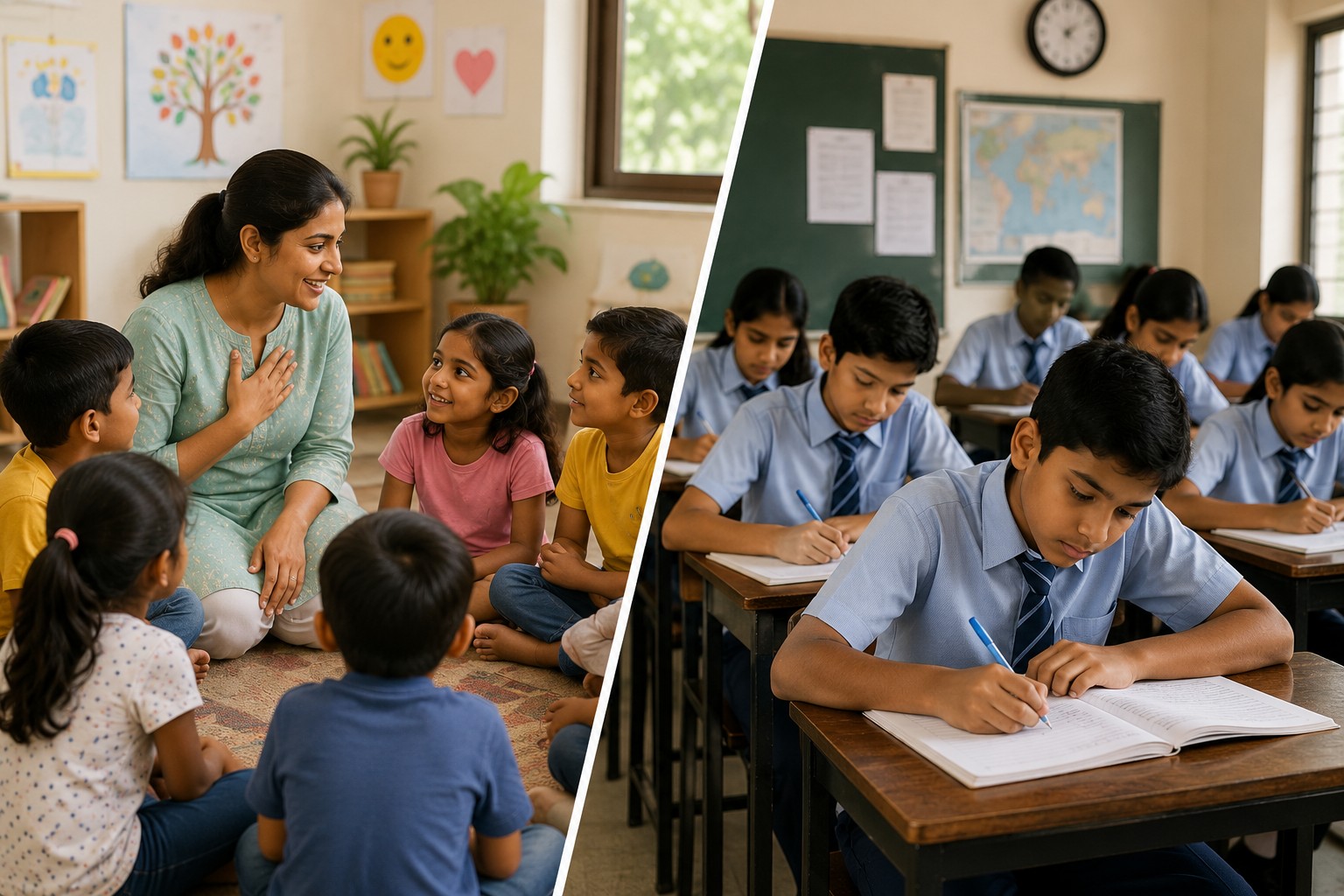
Here's a false choice that's quietly shaping how Indian schools spend every hour of the school day: the idea that academics and emotional development are competing for the same limited time, and that a school investing in one is necessarily sacrificing the other.
It's a compelling story. It's also not what the evidence shows.
The Traditional Model: What It Gets Right, and Where It Runs Out
India's traditional education system is genuinely excellent at one specific thing: transmitting content. Rigorous syllabi, high academic expectations, a culture that takes learning seriously from an early age. That's not nothing — it's produced generations of technically strong graduates who go on to compete globally.
But here's where the model runs out: it was built to measure what a child knows, not how well they can manage themselves or work with other people — and increasingly, those are the exact capabilities the world outside school is actually testing for. Employers across sectors consistently report the same gap: technically sharp graduates who struggle to collaborate, handle feedback, or navigate a disagreement without it becoming personal. That gap isn't a talent shortage. It's a curriculum gap — the traditional model was never designed to close it.
What Social Emotional Learning Actually Adds
Social Emotional Learning — SEL — is the structured teaching of exactly the skills traditional education leaves untouched: managing emotions, building relationships, making responsible decisions. It isn't a replacement curriculum. It's the layer traditional education was always missing, not a competitor to the layer it already does well.
And here's the part that should settle the "which one matters more" debate for good: SEL doesn't come at the cost of academic performance. It improves it. A landmark meta-analysis by Durlak and colleagues, pooling data from 213 school-based SEL programmes and 270,034 students, found an 11 percentile-point gain in academic achievement among students who received SEL instruction, compared to those who didn't. Not a trade-off. A genuine addition.
There's an economic case too, and it's a strong one: a 2015 analysis by Columbia University's Teachers College found that well-implemented SEL programmes return, on average, $11 in value for every $1 invested — through reduced special education needs, lower rates of problem behaviour, and better long-term outcomes for participating students.
Why This Tension Is Especially Sharp in India
India's academic culture runs on intense competition — for marks, for seats, for rank — starting earlier in a child's life than in most education systems worldwide. That pressure has produced real, well-documented consequences: rising rates of academic stress and anxiety among Indian students, alongside growing concern from educators and mental health professionals about the emotional toll of a system almost entirely optimized around test performance. This isn't a fringe concern — it's a pattern serious enough that it's now shaping national policy conversations.
Which is exactly why India's National Education Policy 2020 explicitly mandates "socio-emotional development" and "holistic development" as core requirements, not supplementary goals. Policymakers have already made the call. The open question isn't whether SEL belongs in Indian education — it's how quickly individual schools and families actually catch up to the mandate that already exists on paper.
The Real Answer: Integration, Not Substitution
Here's the framing that resolves the false choice entirely: SEL doesn't need to take time away from academics to work. It needs to be woven into how academics are already taught.
A teacher who asks "how did it feel when you got that answer wrong?" alongside a maths correction is doing both at once. A classroom with a two-minute emotion check-in before a test isn't losing instructional time — it's protecting the instructional time that follows, because a regulated child learns measurably better than a dysregulated one. The choice was never SEL or academics. It's whether a school is willing to teach both in the same breath, rather than treating them as separate budget lines competing for the same clock.
India doesn't need to choose between the rigor that traditional education has always provided and the emotional skill-building SEL adds. It needs both, integrated, starting now — because the evidence suggests that's not an ideological preference. It's the version of education that actually produces the outcomes every stakeholder in this debate says they want: strong academics, and students equipped to handle the world those academics are supposed to prepare them for.
What Schools and Parents Should Do Next
- If you're a parent, ask your child's school directly how SEL is integrated into daily instruction — not whether it exists as a standalone period, but whether it's actually woven into how every subject is taught.
- If you're an educator, look for the smallest integration point first — a feelings check-in before a test, a reflection question alongside a graded assignment — rather than waiting for a full curriculum overhaul.
- Treat NEP 2020's holistic development mandate as a floor, not a ceiling — the policy exists; the real work is in how thoroughly a school chooses to implement it.
The debate was never really SEL versus traditional education. It was always going to be both, working together — the only real question is how long it takes each school to get there.
Happy Sprout Action: Want your child building both academic confidence and emotional intelligence side by side, guided by people who've built exactly this integration? Register your child for a live Happy Sprout SEL class at happysproutminds.com — our CASEL-aligned, NEP 2020-mapped curriculum is taught by trained facilitators across Grades 1–10.
Future Starts Within.