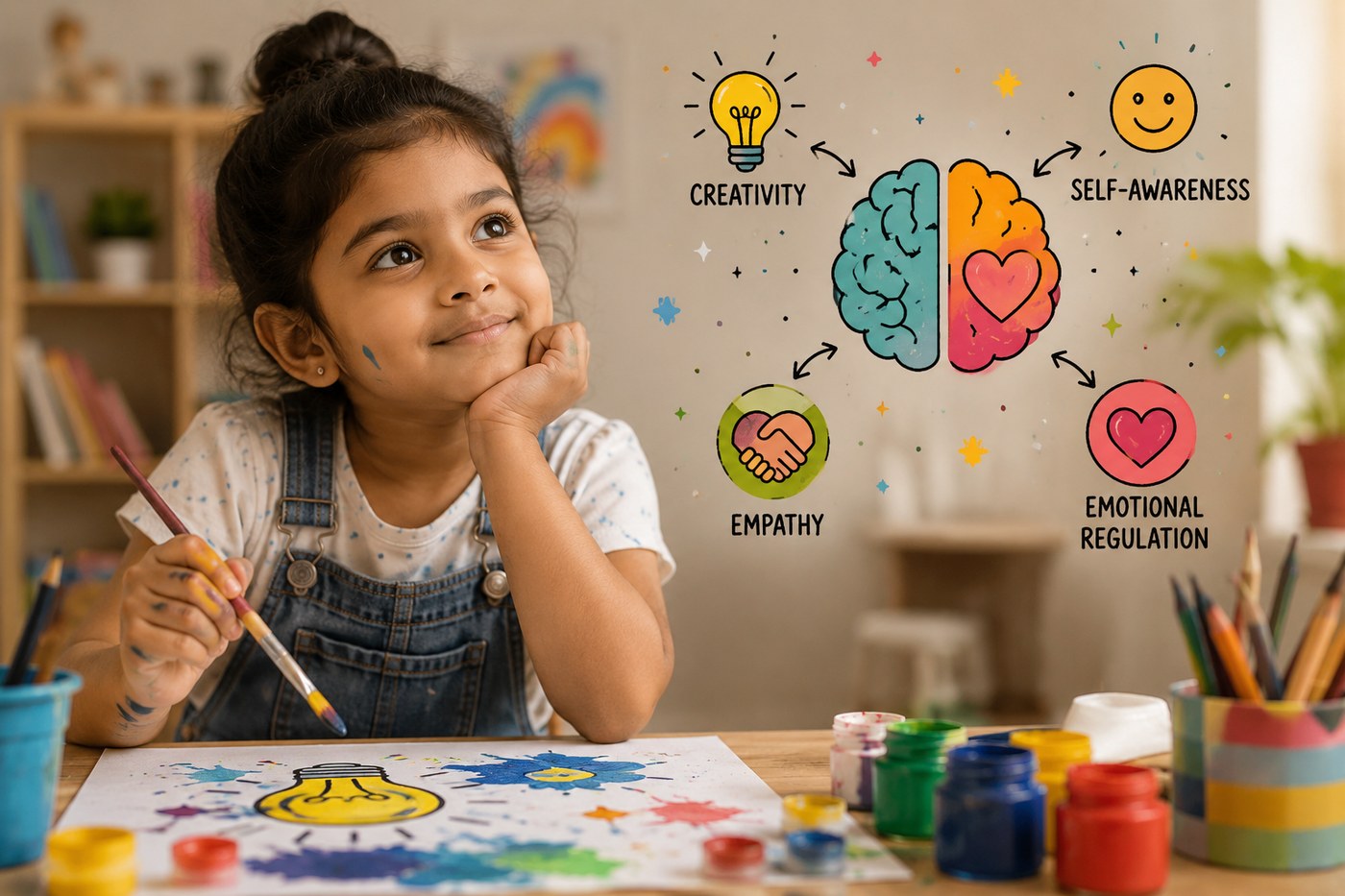
Watch a five-year-old deep in a game of pretend — running a make-believe restaurant, caring for a sick stuffed animal, launching an imaginary spaceship — and it looks, on the surface, like pure entertainment. Developmental psychologist Lev Vygotsky argued something considerably more interesting was happening underneath: pretend play may be where a child's capacity for self-regulation first develops, before it ever shows up anywhere else in their behaviour.
Why Pretend Play Might Be Self-Regulation's First Home
Vygotsky's theory rests on a specific observation: pretend play is inherently rule-bound. A child playing "restaurant" willingly constrains their own behaviour to fit an imagined role — waiting their turn, following the invented logic of the game, staying in character even when it's inconvenient. According to Vygotsky, this voluntary rule-following, chosen rather than imposed, builds the internal capacity for self-regulation in a uniquely powerful way — a child who couldn't yet sit still for an adult's instruction will often willingly "wait patiently" as a pretend waiter, because the constraint comes from a role they've chosen rather than a rule handed down.
It's worth being honest about the current state of this research: a widely cited 2013 review by Angeline Lillard and colleagues challenged how strong the causal evidence actually is, finding the existing research on play's unique causal role in cognitive and self-regulatory development less conclusive than commonly assumed — though subsequent researchers have pushed back on aspects of that review, and the debate over exactly how much of the effect is causal versus correlational continues. What remains well-supported, even amid that debate, is the observed association: children engaged in rich pretend play consistently display more advanced private speech (self-directed talk used to guide their own behaviour) and stronger observed self-regulation in the moment, whatever the precise causal mechanism turns out to be.
Flow: When Creative Absorption Becomes Emotional Regulation
Psychologist Mihaly Csikszentmihalyi's research on flow — a state of complete, energized absorption in a challenging, engaging activity — offers a second, distinct connection between creativity and emotional regulation. Flow states, well-documented across creative activities from drawing to music to building, share a specific signature: time distortion, effortless concentration, and a temporary but genuine reduction in self-conscious rumination and anxious thought.
Here's why this matters for emotional intelligence specifically: flow isn't just a pleasant creative experience — it functions as a genuine, accessible emotion-regulation state. A child fully absorbed in building something, drawing, or imaginative play isn't just having fun; their nervous system is, for that stretch of time, operating in a state that's measurably calmer and more focused than their baseline. Teaching a child to recognize and deliberately seek out their own flow-inducing creative activities gives them a genuine regulation tool — not a distraction from feelings, but a different, equally legitimate way of processing them.
The Cognitive Overlap Between Creative Thinking and Perspective-Taking
Creativity researchers studying divergent thinking — the capacity to generate multiple, varied solutions or interpretations rather than converging on one "correct" answer — have noted a genuine conceptual overlap with a core social-emotional skill: perspective-taking requires the same underlying cognitive move as divergent thinking — generating and holding multiple possible interpretations of the same situation, rather than assuming there's only one.
A child asked to imagine ten different uses for a paperclip is exercising a cognitive muscle strikingly similar to the one exercised by a child asked to imagine ten different reasons a friend might have snapped at them today. Creative thinking practice may be, in a genuine sense, cross-training for empathy — not a separate skill running alongside it, but a related capacity built through some of the same repeated mental exercise.
Creative Expression as an Emotional Outlet
Beyond the cognitive mechanisms, there's a simpler, more intuitive connection worth naming directly: creative activities give children a genuine outlet for emotional content they may not yet have words for. A child who can't articulate exactly why they're upset can often draw it, act it out in pretend play, or express it through a piece of music or a story — accessing and externalizing something real even without the verbal vocabulary a direct conversation would require.
This isn't a claim that creative activity substitutes for genuine emotional processing or professional support when it's needed — it's a narrower, well-supported observation: creative expression offers a legitimate, accessible channel for emotional content, particularly for children whose verbal emotional vocabulary hasn't caught up yet with what they're actually feeling.
How to Actually Build This Connection
Protect unstructured pretend play time, especially for younger children, rather than filling every hour with structured, adult-directed activities — the self-regulation practice embedded in child-led pretend play is difficult to replicate through instruction alone.
Notice and name your child's flow states. "You were so absorbed in that drawing, you didn't even hear me call you" — said with genuine interest, not frustration — helps a child start to recognize their own flow-inducing activities as things they can deliberately return to when they need to reset.
Use creative prompts explicitly tied to perspective-taking. "Draw how you think the character felt" or "make up a different ending where the character chose differently" trains the same divergent-thinking muscle in a way that's also directly perspective-taking practice.
Offer creative expression as a genuine option when a child struggles to articulate a feeling — "you don't have to tell me in words, you could draw it or act it out if that's easier" — rather than insisting on verbal processing as the only valid channel.
What to Do This Week
- Protect at least one stretch of genuinely unstructured, child-led pretend play or creative time this week, resisting the urge to direct or structure it.
- Notice one flow state your child enters this week and name it afterward, building their own awareness of it as a tool they have access to.
- Try one creative perspective-taking prompt — drawing or acting out how someone else might have felt in a real or story situation — and notice how it lands compared to a direct verbal question.
The connection between creativity and emotional intelligence was never a coincidence worth dismissing as "kids just like to play." The research points toward something more structural: creative activity may be one of the most natural, accessible training grounds a child has for the exact regulatory and perspective-taking skills SEL is trying to build.
Happy Sprout Action: Want your child building emotional intelligence through genuinely creative, engaging practice rather than a worksheet? Register your child for a live Happy Sprout SEL class at happysproutminds.com, guided by a trained facilitator.
Future Starts Within.