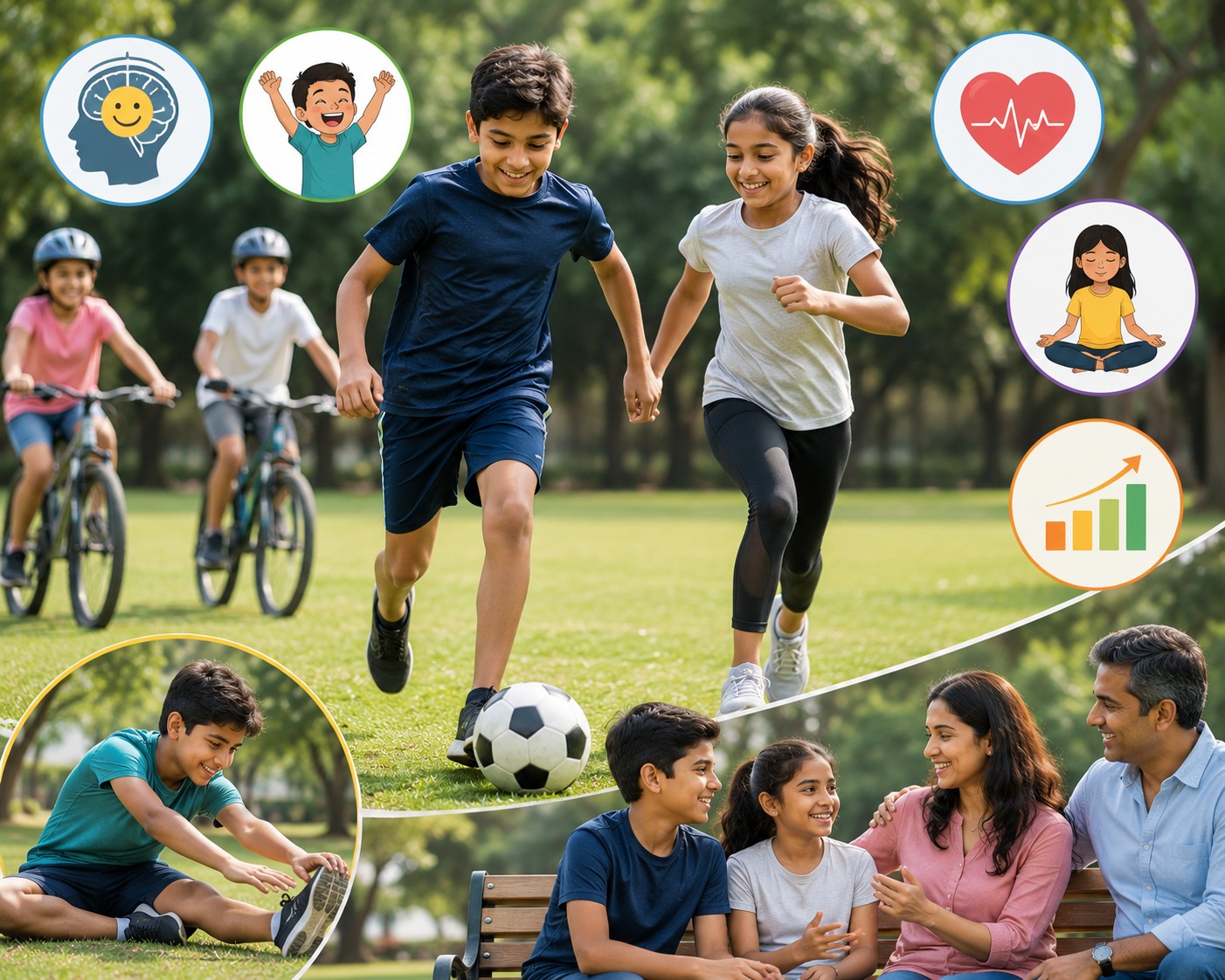
Here's a question worth asking honestly: if a single, free, widely available intervention measurably improved a child's mood, focus, and stress resilience, would you make time for it every day? That intervention already exists, most families already have access to it, and it's chronically under-prioritized compared to almost everything else on a child's schedule: plain, regular physical activity.
Here's what the actual research shows — the mechanism, the evidence, and what kind of movement genuinely does the most for a child's emotional health.
The Evidence: What a Major Meta-Analysis Actually Found
A comprehensive 2019 systematic review and meta-analysis, published in Sports Medicine by Rodriguez-Ayllon and colleagues, pooled findings across a large body of research on physical activity and mental health in preschoolers, children, and adolescents. The conclusion was clear on the intervention side: physical activity interventions were found to improve adolescents' mental health, and observational research pointed in the same direction for children more broadly — higher physical activity and lower sedentary behaviour were consistently associated with better mental health outcomes.
This isn't an isolated finding. Multiple independent reviews — including earlier Cochrane-level reviews on exercise and youth anxiety and depression — have converged on a similar pattern: movement measurably helps, and inactivity measurably doesn't. The researchers themselves are appropriately careful about the strength of causal claims in children specifically (more of the strongest evidence is in adolescents), but the direction of the finding is remarkably consistent across the literature.
Why Movement Affects Emotion: The Actual Mechanism
Here's what's happening under the surface, in plain terms:
Exercise triggers the release of endorphins and other neurochemicals that directly improve mood in the hours following activity — this is the most immediate, short-term mechanism, and it's why a genuinely bad-mood afternoon can shift noticeably after twenty minutes of running around.
Regular activity supports the production of BDNF (brain-derived neurotrophic factor), a protein that supports the growth and health of neurons, particularly in brain regions involved in mood regulation and stress response. This is a slower-building, longer-term mechanism — not a same-day mood boost, but a genuine contributor to a more resilient baseline over weeks and months of consistent activity.
Physical activity reliably improves sleep quality, and sleep quality is one of the single strongest levers on a child's emotional regulation capacity the next day. A child who's more physically active during the day tends to fall asleep faster and sleep more soundly — which means better-regulated emotions the following morning, almost as a side effect.
Exercise provides a legitimate outlet for physiological arousal. A child who's anxious or frustrated is carrying real physical tension — elevated heart rate, muscle tightness, excess adrenaline. Movement gives that physiological state somewhere productive to go, rather than staying bottled up until it surfaces as an outburst later.
Not All Activity Builds the Same Skills
Here's a distinction worth making that most general "get your kids moving" advice skips: different types of physical activity build different emotional and social skills, not just fitness.
Team sports specifically build cooperation, communication, handling both winning and losing gracefully, and reading social dynamics in real time — skills that overlap directly with several CASEL competencies, not just physical health.
Individual activities — running, swimming, cycling, martial arts — tend to build self-discipline, personal goal-setting, and the ability to self-motivate without external social pressure, a genuinely different emotional skill set than team sports develop.
Outdoor activity specifically appears to add benefits beyond the exercise itself — research on attention restoration and the calming effects of natural environments suggests that movement outdoors may support emotional regulation somewhat more than equivalent indoor activity, though this specific comparison has less robust research behind it than the broader physical-activity findings.
The practical implication: a genuinely well-rounded approach probably includes both team and individual activity over the course of a child's week, rather than treating "exercise" as a single interchangeable category.
What This Means for a Child Who's Already Struggling
If your child is dealing with anxiety, low mood, or difficulty regulating big emotions, physical activity isn't a replacement for professional support when that's genuinely needed — but it's a legitimate, evidence-backed complement to it. Several of the meta-analyses in this space specifically found meaningful effects on anxiety and depressive symptoms in children and adolescents, which is a stronger claim than "exercise is generally good for you" — it's specifically relevant to emotional struggle, not just general wellness.
What to Do This Week
- Don't wait for a "good mood" to prioritize movement — use it precisely when your child seems dysregulated. The mechanism suggests physical activity works especially well as an intervention during a rough patch, not just as prevention on an easy day.
- Mix team and individual activity across the week, rather than defaulting to only one type — each builds a genuinely different set of emotional and social skills.
- Favour outdoor movement when it's a realistic option, even something as simple as an evening walk instead of an indoor activity of similar intensity.
Physical activity was never just about fitness. The research increasingly treats it as something closer to a core emotional-regulation tool — one that happens to be free, widely available, and chronically under-prioritized compared to almost everything else competing for a child's time.
Happy Sprout Action: Want your child building emotional regulation skills alongside active, engaging practice — not just sitting through another lecture? Register your child for a live Happy Sprout SEL class at happysproutminds.com, where movement and reflection are woven directly into every session, guided by a trained facilitator.
Future Starts Within.