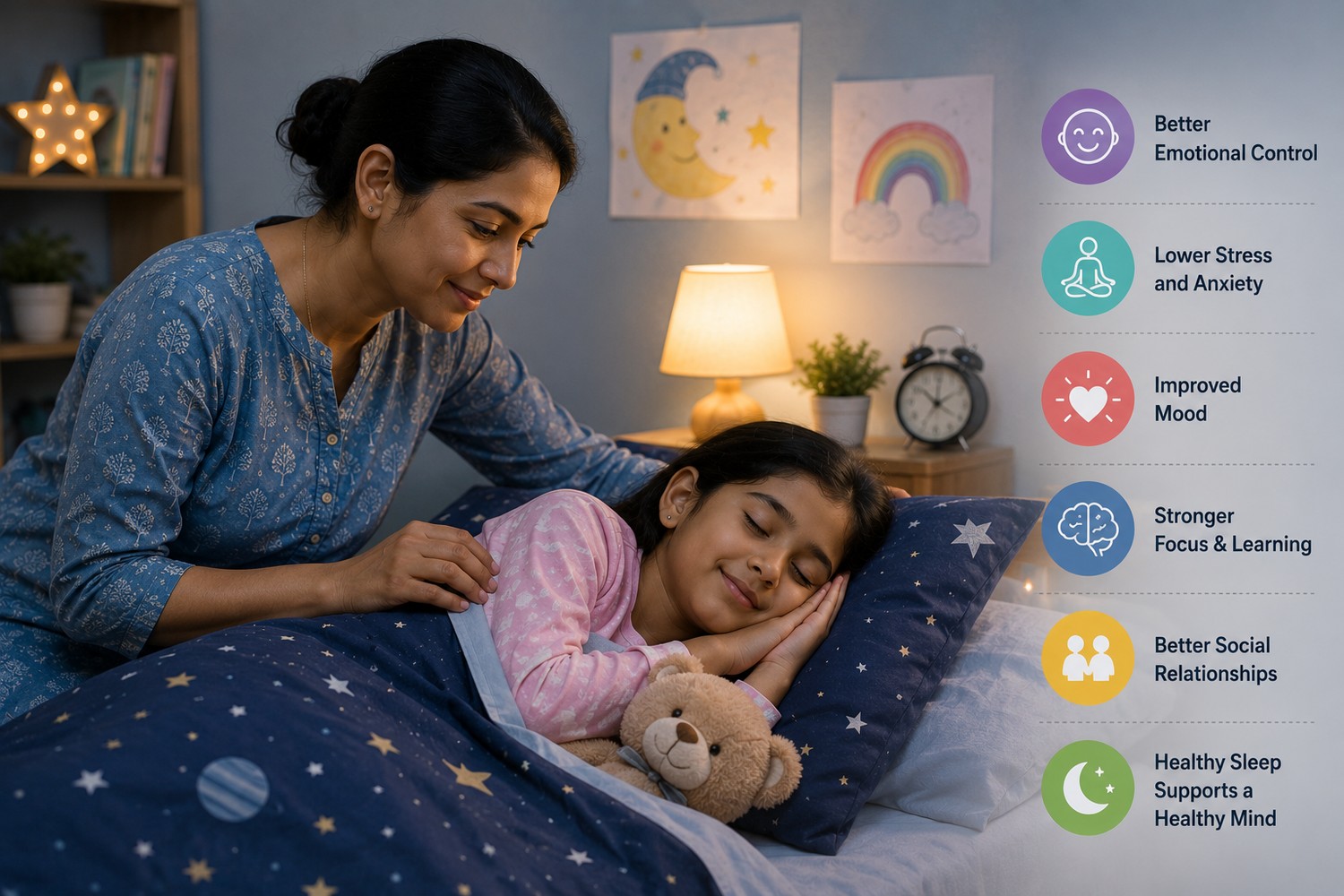
A team of neuroscientists at Harvard and UC Berkeley put people in an fMRI scanner and showed them emotionally distressing images — once after a normal night's sleep, once after being kept awake all night. The well-rested brain showed a measured, appropriately proportioned response. The sleep-deprived brain showed something more dramatic: the amygdala — the brain's alarm system — lit up roughly 60% more intensely to the same disturbing images, while its connection to the prefrontal cortex, the region responsible for keeping that alarm in check, was measurably weaker.
The researchers, led by Seung-Schik Yoo and Matthew Walker, described the finding plainly: sleep deprivation causes a "prefrontal-amygdala disconnect." In practical terms, a tired brain's emotional brakes and its emotional accelerator stop communicating properly. This is the actual neuroscience behind something every parent already knows intuitively: a tired child isn't just cranky. Their brain is, quite literally, less equipped to regulate what it's feeling.
Why This Matters More for Children Than Adults
The prefrontal cortex — the region whose connection to the amygdala weakens under sleep deprivation — is already the last part of the brain to fully mature, continuing to develop into a person's mid-twenties. A child's regulatory system is already working with less mature "brakes" than an adult's on a good night's sleep. Layer sleep deprivation on top of that already-developing system, and the gap between emotional alarm and emotional control widens even further than it would in an adult.
This is part of why an overtired child's meltdown over something genuinely minor — a wrong-coloured cup, a denied second snack — can feel wildly disproportionate to the trigger. It often is disproportionate, and the sleep-deprived brain is a real part of why.
How Much Sleep Children Actually Need
Sleep guidelines from major pediatric health bodies converge on a fairly consistent range by age:
- Ages 3–5: 10–13 hours, including naps where applicable
- Ages 6–12: 9–12 hours
- Ages 13–18: 8–10 hours
Here's the uncomfortable reality worth naming directly: most children, especially in academically competitive environments with heavy homework loads, are chronically getting less than these ranges, often without parents realizing the gap has become the norm rather than the exception. A child who's "getting by" on an hour or two less than their range isn't necessarily showing obvious exhaustion — the effects often show up sideways, as irritability, difficulty focusing, or emotional overreaction, rather than as visible sleepiness.
The Compounding Effect: Sleep Debt
A single late night has a measurable effect on next-day regulation, but the more concerning pattern is cumulative sleep debt — a child consistently getting even 30–60 minutes less than they need, night after night, building a deficit that doesn't fully resolve with one good night's sleep on a weekend. Research on sleep debt has found that its effects on mood, attention, and emotional regulation tend to compound rather than reset quickly, which means the standard "catch up on weekends" approach many families rely on often doesn't fully restore what's been lost across a demanding school week.
Sleep and Emotional Memory: The REM Connection
There's a second, less commonly discussed mechanism worth understanding: REM sleep specifically appears to play a role in processing and consolidating emotional experiences, not just general memories. Matthew Walker's broader body of research on sleep and emotion suggests that REM sleep functions almost like an overnight therapy session — helping the brain process a difficult emotional experience from earlier in the day and file it away with reduced emotional intensity by morning.
A child who's chronically short on sleep, particularly REM-rich sleep in the later parts of the night, may not be getting the full benefit of this overnight processing — meaning difficult emotional experiences from the day before can carry more unprocessed intensity into the next day than they otherwise would.
What Actually Helps
Treat sleep as a non-negotiable input to emotional regulation, not a separate wellness category. If a child is struggling with frequent meltdowns or emotional volatility, sleep is worth auditing before assuming the issue is purely behavioural or emotional in origin.
Protect a consistent bedtime and wake time, including on weekends. Circadian rhythm regulation depends heavily on consistency — a wildly variable sleep schedule undermines sleep quality even when total hours look adequate on paper.
Build a wind-down routine that starts before the "lights out" moment. The transition into sleep isn't instant; a consistent 20–30 minute wind-down — dimmer lighting, calmer activity, no screens — gives the body's sleep systems time to actually engage before the child is expected to fall asleep.
Watch for sideways signs of sleep debt, not just visible tiredness. Increased irritability, more frequent meltdowns over small triggers, or difficulty concentrating can all be sleep-debt symptoms even when a child doesn't seem obviously sleepy.
Don't treat weekend catch-up sleep as a full solution. While extra weekend sleep helps, it doesn't fully reverse a week's accumulated deficit — the more effective fix is protecting adequate sleep consistently, rather than relying on recovery afterward.
What to Do This Week
- Calculate your child's actual average sleep this week against the age ranges above, and notice honestly whether there's a gap between what they're getting and what they need.
- Protect one specific bedtime boundary this week — even 20–30 minutes earlier — and observe whether next-day emotional regulation shifts noticeably.
- If your child has been unusually volatile lately, check sleep before assuming the cause is purely behavioural — the neuroscience suggests it's often a meaningful part of the picture, not a separate issue.
A tired child was never simply being difficult. Their brain, measurably, has less capacity in that moment to do the regulatory work being asked of it — which makes sleep one of the most under-recognized, highest-leverage tools available for a child's emotional stability.
Happy Sprout Action: Want your child building genuine emotional regulation skills that work with a well-rested brain, not against a tired one? Register your child for a live Happy Sprout SEL class at happysproutminds.com, guided by a trained facilitator.
Future Starts Within.