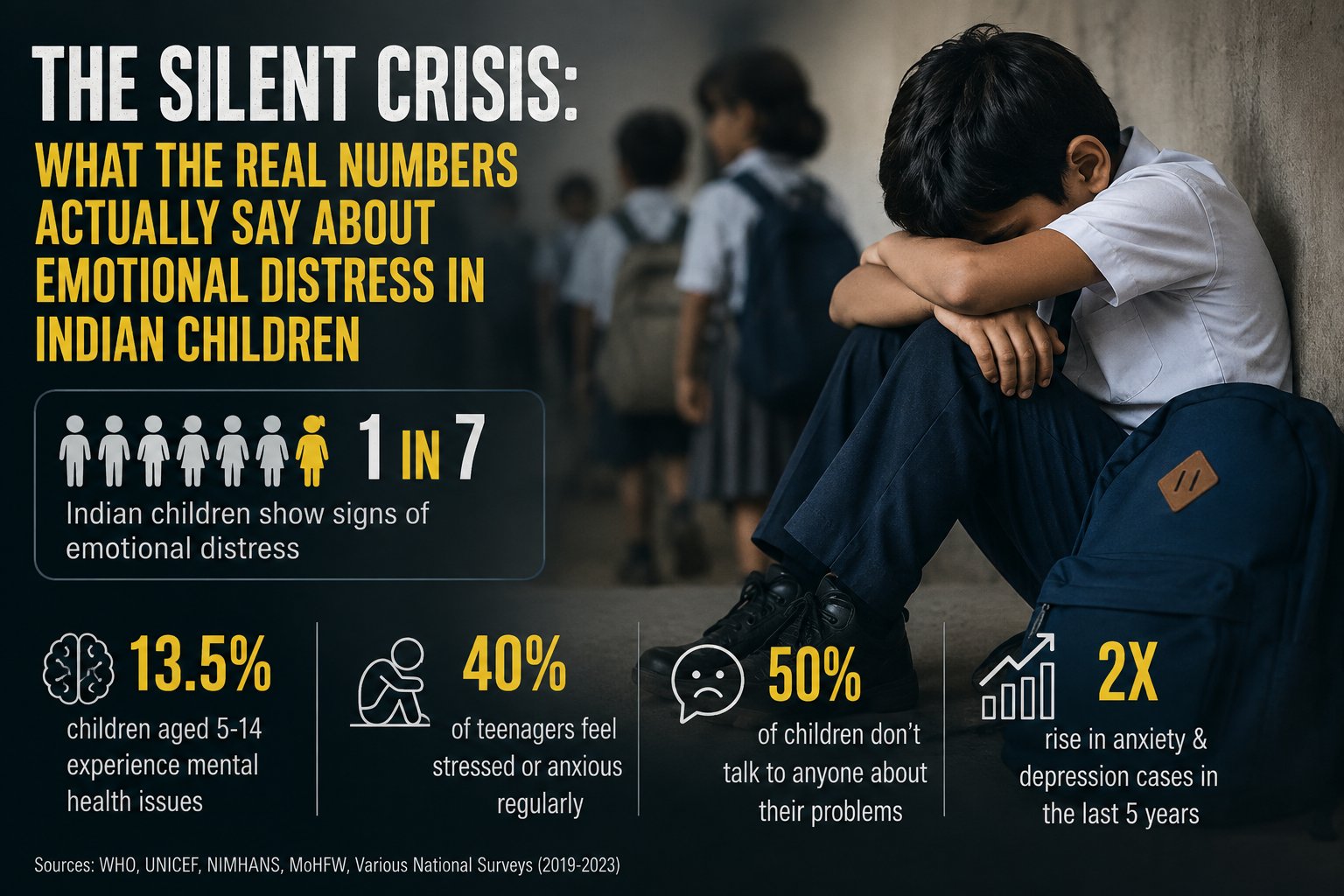
Numbers about children's mental health get thrown around constantly, and honestly, a lot of them don't hold up well under a closer look. So before making any claim about how widespread emotional distress actually is among Indian children, it's worth doing the less exciting thing first: looking at what the actual published research says, study by study, rather than reaching for the single most dramatic number available.
Here's the honest picture — and it's concerning enough without needing to be oversold.
What the Research Actually Shows
A large-scale study by Malhotra and colleagues found the prevalence of mental health issues among Indian schoolchildren to be 23.33% — genuinely close to one in four — compared to a considerably lower 6.46% measured at the general community level. That gap between the school-based figure and the community figure is itself worth noting: whatever's happening seems to concentrate specifically around the school environment, not distributed evenly across a child's whole life.
Other individual studies paint an even wider, messier range: research in rural schools in Haryana and West Bengal found prevalence rates of 20.7% and 33.33% respectively, while a study of urban schoolchildren in Tamil Nadu found 33.7%. A separate study in Bangalore found an overall prevalence of 12.5%, varying by setting — 12.4% in rural areas, 10.8% in slums, 13.9% in urban areas. India's National Mental Health Survey (2016), the most methodologically robust national data available, found 7.3% prevalence of psychological morbidity among adolescents aged 13–17 — notably lower than many of the individual school-based studies, and specifically measuring a teenage population rather than children under 12.
The honest synthesis: there is no single, clean, universally agreed "X% of Indian children" figure — the range across credible, published studies runs from roughly 7% to over 30%, depending heavily on methodology, age range studied, and whether the sample is drawn from schools, clinics, or the general community. What's consistent across nearly all of them is the underlying signal: this is not a rare or marginal issue. Several independent studies, using different methods in different regions, converge on the idea that a substantial minority of Indian children and adolescents — plausibly somewhere in the range of one in four in school settings specifically — show measurable signs of emotional or behavioural distress.
Why the Range Itself Is Informative
The wide variation between studies isn't just statistical noise — it points to something genuinely useful: prevalence differs meaningfully by setting, with school-based studies consistently finding higher rates than community-wide samples. This suggests the school environment specifically — academic pressure, social dynamics, comparison, the sheer number of waking hours spent there — plays a real, measurable role in whether distress shows up or stays invisible.
It's also worth naming plainly: much of the most rigorous national data focuses on adolescents (13–17), while data specifically isolating children under 12 is considerably thinner and more inconsistent across the literature. This is itself part of the "silent" problem — younger children's emotional distress is measured less often and less rigorously than teenagers', which means whatever the true prevalence is in that younger age group, researchers currently have a weaker picture of it than the numbers for older kids.
Why This Stays Invisible to Parents
None of the studies above required a child to say, in words, "I am struggling." Distress at this age most often shows up as behaviour — irritability, withdrawal, physical complaints, drops in engagement — precisely the kinds of signals a parent can easily misread as a discipline issue, a phase, or simple moodiness, rather than a genuine signal worth taking seriously. Without a working vocabulary for emotions and specific behavioural literacy, both the child and the parent can miss what's actually happening for months, sometimes longer.
What to Actually Watch For
Persistent behavioural change, not a single bad day — a shift in mood, engagement, or sleep that holds for weeks, not an isolated rough afternoon.
Physical complaints without a clear medical cause — stomachaches, headaches, or fatigue that cluster around specific triggers like school mornings or tests.
Withdrawal from things that used to bring genuine enjoyment — a meaningful drop in interest, not just a passing preference shift.
Academic engagement dropping without an obvious explanation — distinct from a single disappointing grade, this is a broader pattern of disengagement worth investigating rather than simply correcting.
What to Do This Week
- Take the numbers seriously without taking any single statistic as gospel — the honest range across studies is itself the useful information: this is common enough that it's worth active attention in any household, not a rare edge case.
- Build a regular, low-key check-in habit rather than waiting for a crisis to prompt the first real conversation — much of what the research shows stays invisible precisely because nobody was looking for it early.
- Learn the behavioural signals above, since most distress at this age shows up in behaviour long before it shows up in words a child can articulate directly.
If you're concerned about a specific child's emotional wellbeing, please consult a qualified mental health professional — the research summarized here describes population-level patterns, not a diagnostic tool for any individual child.
The real crisis was never really about which exact percentage is correct. It's that a meaningful share of children — by every credible study's estimate, a genuinely significant minority — are showing real signs of distress that go unnoticed, simply because nobody in the room was trained to look for the actual signals.
Happy Sprout Action: Download our free infographic, "The Numbers Behind the Silence" — the research mapped to everyday behaviours you can actually recognize — and register your child for a live Happy Sprout SEL class at happysproutminds.com, guided by a trained facilitator.
Future Starts Within.