Let's start with a number that should stop you mid-scroll.
Researchers tracked 270,034 students across 213 separate studies. Every single study measured the same thing: what happens when kids get structured practice in managing emotions, building relationships, and making good decisions — alongside their regular academics, not instead of them.
The result? An 11 percentile-point jump in academic achievement, on average, compared to kids who didn't get that training.
Read that again. Not 11 percentile points from more tutoring. Not from a better textbook. From teaching kids what to do with their feelings.
That's Social Emotional Learning — SEL, for short. And if you've never heard the term before, you're not alone. Most Indian parents haven't. But your child's school probably has to have heard of it, because — as you'll see below — the government has quietly made it mandatory.
Let's break down exactly what it is, why it works, and what you can start doing about it tonight.
What Is Social Emotional Learning (SEL), Exactly?
Here's the simplest way to put it: academic education builds the mind. SEL builds the person behind the mind.
Formally, Social Emotional Learning is the process through which children (and adults, honestly) develop the skills to manage their emotions, build healthy relationships, and make responsible decisions. It was formalized by researchers at Yale in the 1990s and has since become the standard framework for children's development programs in over 50 countries.
It is not a separate subject. It's not a once-a-week "feelings class." It's woven through ordinary moments — which is exactly why most parents miss it happening, even when it's working.
The CASEL Framework: 5 Skills Every Child Actually Needs
If you search "what is SEL," you'll run into CASEL fast — the Collaborative for Academic, Social, and Emotional Learning, the field's leading research body. CASEL breaks SEL down into five specific, teachable competencies. Here they are, in plain language:
- Self-Awareness — Can your child identify what they're feeling and why? A self-aware kid knows they're anxious about a test, not just that they feel "weird."
- Self-Management — Can they regulate the feeling once they've named it? This is the difference between a child who loses a game and sulks for five minutes versus one who throws the board across the room.
- Social Awareness — Can they read what someone else is feeling, including people different from them? This is empathy, made practical.
- Relationship Skills — Can they communicate clearly and resolve conflict without it becoming a fight?
- Responsible Decision-Making — Can they make ethical, sensible choices about their own behaviour, even under peer pressure?
Notice what's missing from that list: nothing about test scores. And yet, as you saw above, mastering these five skills is what moves test scores.
Why IQ Alone Won't Cut It Anymore
Quick myth-check before we go further, because this one gets repeated constantly and it's wrong: you may have heard that "EQ accounts for 80% of career success." That statistic gets attributed to Daniel Goleman, the psychologist who popularized emotional intelligence with his 1995 bestseller. Here's the twist — Goleman himself has publicly called this exact claim a myth, a misreading of his research that took on a life of its own online. IQ still matters, a lot, for getting hired in the first place.
What the research does support is more specific, and honestly more useful: emotional intelligence is what separates good performers from star performers once people are already in the room. Google's own internal research (Project Oxygen) found that among the top qualities of its best managers, technical expertise ranked dead last — coaching, empathy, and listening topped the list.
The takeaway for parents: IQ gets your child into the room. EQ determines what happens once they're in it. Building only one of these is building half a child.
NEP 2020 Just Made This Non-Negotiable for Indian Schools
Here's something most Indian parents don't know: India's National Education Policy 2020 explicitly requires schools to address "socio-emotional development" and "holistic development." The policy names empathy, resilience, and ethical reasoning directly — all core SEL competencies.
In other words, this isn't a nice-to-have imported trend. It's now policy. The only real question left is whether your child's specific school is actually implementing it — or just has it buried in a mission statement nobody's acted on.
If you're not sure, that's worth a direct question to your child's school. "How are you building self-awareness and self-management into the curriculum?" is a fair thing to ask, and a school genuinely doing SEL will have a specific answer, not a vague one.
What SEL Actually Looks Like on a Normal Day
This is where most parents get confused, because SEL doesn't look like a lesson. It looks like ordinary conversations, done a specific way:
- A teacher asking, "How did it feel when you got that answer wrong?" instead of just marking it incorrect and moving on — that's SEL.
- A parent saying, "You seem frustrated — can you tell me what's happening inside?" instead of "stop being dramatic" — that's SEL.
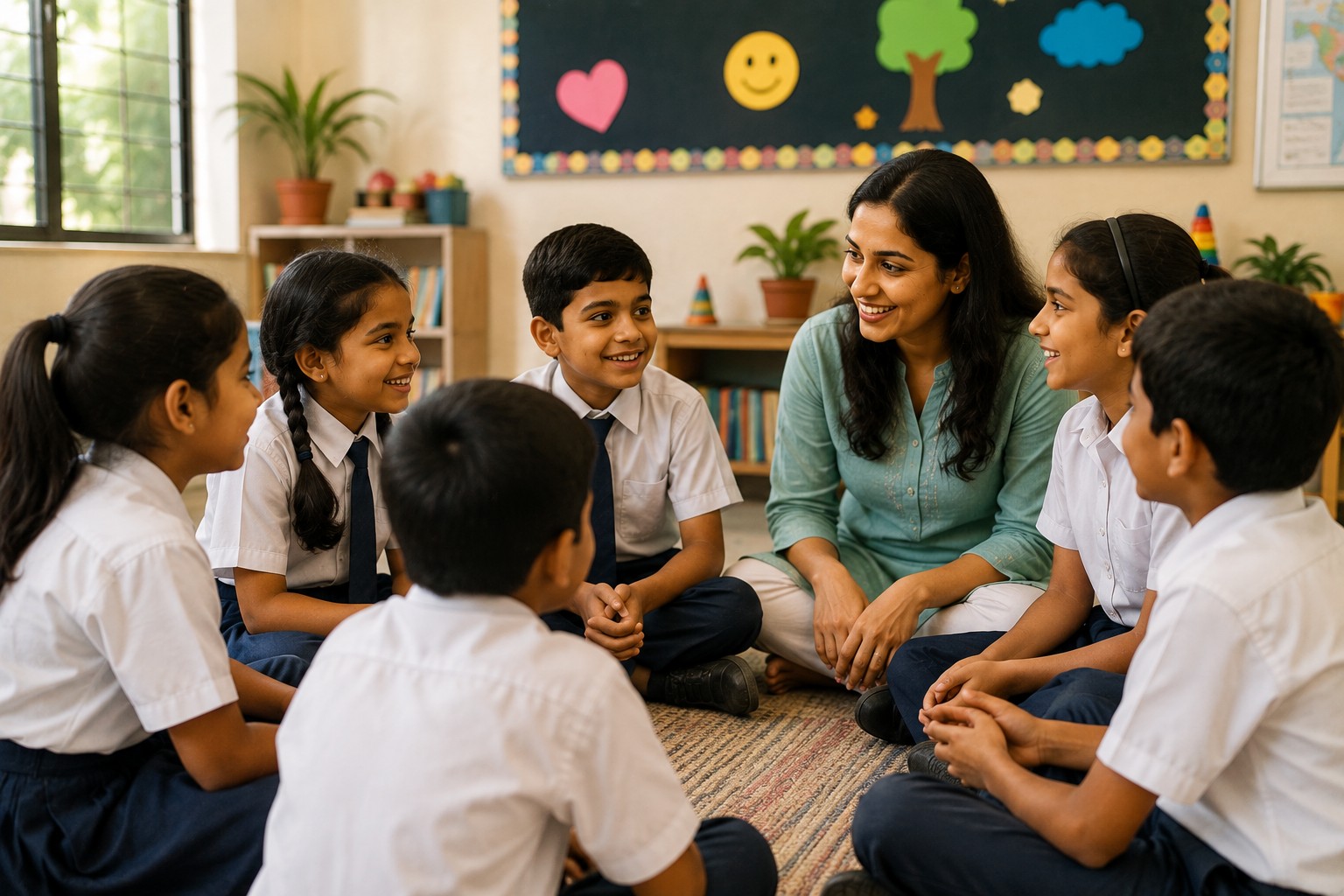
- A classroom with a quiet "calm corner" and a two-minute daily emotion check-in — that's SEL, delivered without anyone calling it a class.
You don't need a curriculum to start. You need to change the question you ask.
3 SEL Rituals You Can Start at Home Tonight
No app, no course, no cost. Just three habits, repeated consistently:
1. The Rose-Thorn-Bud Dinner Ritual. Each evening, everyone at the table shares one Rose (a highlight of the day), one Thorn (a challenge), and one Bud (something they're looking forward to). It sounds almost too simple to matter — but it builds emotional vocabulary, connection, and optimism in a single five-minute habit, three SEL outcomes at once.
2. The Morning Feelings Check-In. Ask your child to rate how they're feeling on a scale of 1 to 10, and name the emotion behind the number. Over weeks, this quietly builds self-awareness — CASEL competency #1 — without your child ever feeling like they're "doing an exercise."
3. The 3-Step Repair Conversation. When conflict happens at home — and it will — walk through three questions together: What happened? How did we each feel? What can we do differently next time? This single habit is relationship skills (CASEL competency #4) in direct action.
Pick one. Not all three. Run it for two weeks before adding the next.
The Bottom Line
Social Emotional Learning isn't a buzzword, and it isn't optional anymore — not with NEP 2020 requiring it and 213 independent studies backing its academic impact. It's the skillset sitting underneath every other skillset your child is trying to build.
The good news: you don't need a certification or a special program to start today. You need three dinners, three mornings, and one hard conversation, handled a little differently than before.
Happy Sprout's CASEL-aligned SEL programme is built specifically for Indian children aged 6–16. Explore our free parent resources at happysproutminds.com and give your child the skills that actually last a lifetime.
Future Starts Within.