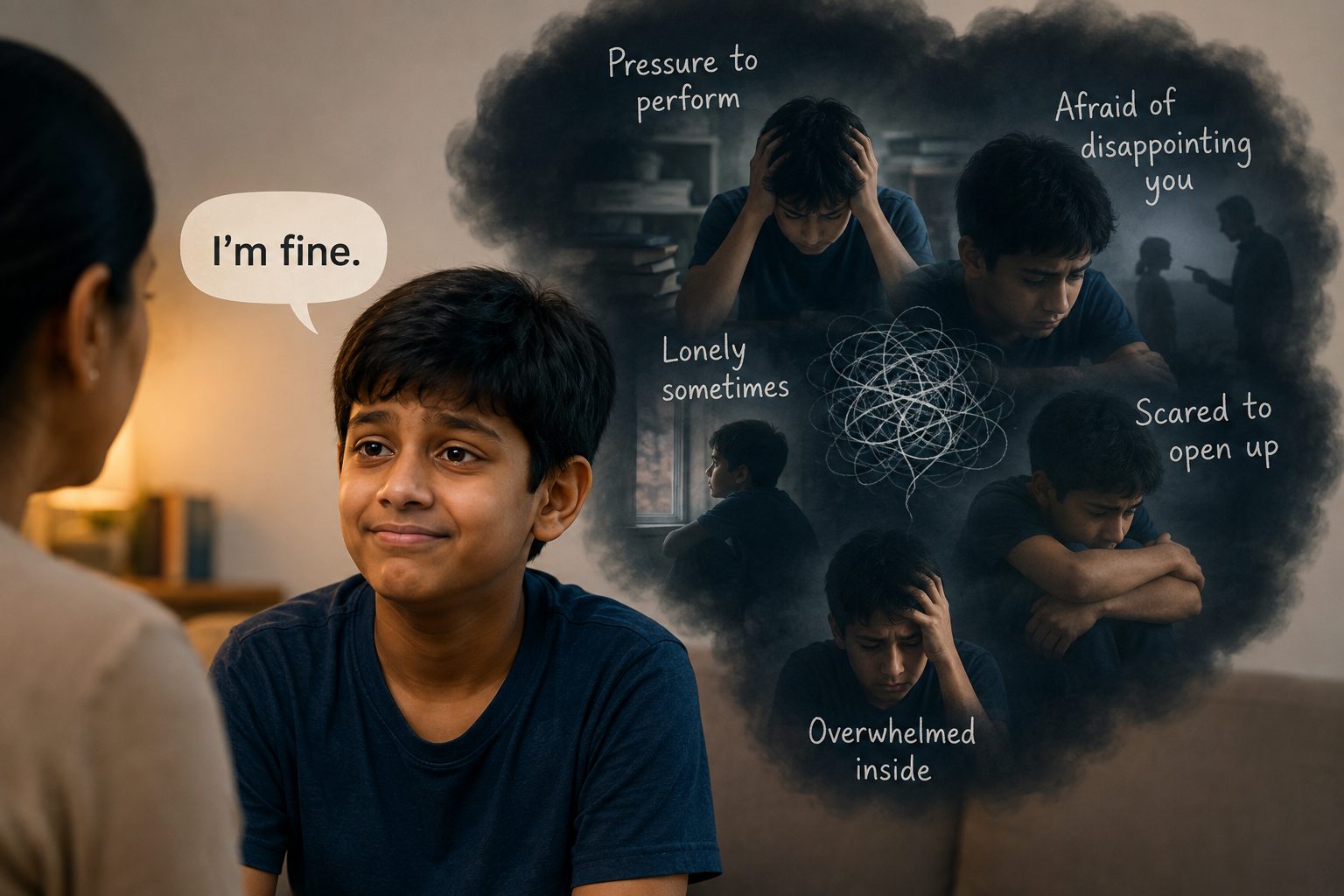
For decades, researchers studying how well parents actually know what's going on in their children's lives assumed the answer came down to effort: how closely a parent monitored, questioned, and tracked their child. Then, in a body of research led by Håkan Stattin and Margaret Kerr, that assumption got overturned. Voluntary disclosure — the child's own choice to share — turned out to be the single most powerful predictor of what a parent actually knows, far outweighing active parental monitoring or questioning. In one study of over 1,000 Swedish teenagers, disclosure alone predicted roughly 15% of the variance in a child's behavior; adding parental effort on top of that barely moved the number.
Here's the reframe that finding demands: your child isn't a locked box you need better tools to pry open. They're an active participant, constantly deciding, moment to moment, whether sharing with you is worth it. "Fine" isn't a wall you failed to breach. It's a choice — and choices, unlike locks, respond to something specific: what's happened the last several times they chose to share.
Disclosure Is a Decision, Not a Personality Trait
This distinction matters enormously. A child who says "fine" isn't necessarily secretive by nature, and increasing surveillance — more questions, closer tracking, checking their phone — doesn't reliably fix it, because disclosure is fundamentally relational, not something that can be extracted through better monitoring technique. The research consistently finds that a child's willingness to voluntarily share is shaped by how safe and worthwhile sharing has felt in the past, not by how thoroughly a parent asks.
This reframes the "I'm fine" reflex specifically: it's not (only) a vocabulary gap, and it's not (only) a cultural norm about composure. It's frequently a learned, active decision — built from a track record of what happened the last several times this specific child shared something real with this specific parent.
What Actually Shapes the Decision to Share or Conceal
How past disclosures were received. A child who shared something vulnerable and got a calm, genuinely curious response learns that sharing is safe. A child who shared and got an immediate lecture, dismissal, or punishment learns something very different — and that lesson generalizes forward, well beyond the specific topic that triggered it.
Whether sharing led to consequences beyond the conversation itself. If admitting "I got in trouble at school" led directly to punishment with no space for the child's side of the story, the child learns that disclosure is risky in a very concrete, practical sense — not just emotionally uncomfortable, but something with real downstream costs.
Whether the parent's reaction matched the actual size of the issue. A minor admission met with an outsized reaction — genuine panic, anger far beyond the scale of what was shared — teaches a child to calibrate down what they reveal next time, since the emotional cost of disclosure clearly exceeded what the situation warranted.
Whether previous check-ins felt like genuine curiosity or interrogation. The research on disclosure specifically distinguishes it from information extracted through parental solicitation — a child sharing because they want to is a fundamentally different experience, and produces different long-term willingness, than a child sharing because they've been cornered into it.
Why This Matters More Than Any Single Conversation Technique
Here's the deeper implication: you cannot ask your way into disclosure with a clever enough question. A well-crafted question might get past "fine" once. But if the underlying pattern — how past sharing has actually gone — hasn't changed, the effect fades fast. The real lever isn't the question. It's the accumulated track record your child is drawing on when deciding whether this particular moment is worth the risk of being honest.
This is genuinely good news, even though it sounds like more work: a track record can be rebuilt. It doesn't require a single perfect conversation — it requires a consistent pattern, over time, of disclosure being met with curiosity rather than immediate consequence, calibrated reactions rather than outsized ones, and genuine interest rather than interrogation.
How to Actually Rebuild the Track Record
Separate the information from the immediate consequence, at least at first. When your child shares something difficult, resist moving straight to discipline. A brief "thank you for telling me, let's figure out what happens next" separates the safety of disclosure from its downstream handling — and signals that sharing itself won't automatically trigger punishment.
Match your reaction to the actual size of what's shared. A visibly outsized emotional response to a minor disclosure teaches a child to hide the medium-sized things next time, just to avoid triggering that same reaction again.
Notice whether your check-ins feel like curiosity or extraction. "What happened today?" asked with genuine, unhurried interest lands completely differently than the same words asked while multitasking or already anticipating a specific answer.
Give it time and repetition, not a single reset conversation. Since disclosure is built from an accumulated track record, rebuilding it takes a consistent pattern over weeks and months — not one especially good conversation, however well-executed.
What to Do This Week
- Honestly audit your own recent reactions to something your child has shared — were they calibrated to the actual size of the issue, or did they escalate faster than the situation warranted?
- The next time your child discloses something difficult, separate acknowledgment from consequence — "thank you for telling me" first, problem-solving second, not fused into one reaction.
- Notice whether your check-ins feel like genuine curiosity to your child, not just to you — the difference is often more visible from their side of the conversation than yours.
Your child was never simply lying to you about being fine. They were making an active, reasonable calculation — based on real evidence from real past experience — about whether being honest with you, right now, was actually worth it.
Happy Sprout Action: Download our free Emotional Check-In Conversation Guide and register your child for a live Happy Sprout SEL class at happysproutminds.com to build the kind of consistent, trusted relationship that makes genuine disclosure feel safe, guided by a trained facilitator.
Future Starts Within.